Sunday, April 21, 2019

Signs Of Spring

     Although March seemed endless this year, April is here at last. There is nothing good to be said about March, other than it is over.  Daylight Savings Time arrived early this year giving us more light at the end of the day, thus more time to consider the state of the garden.  By mid-March some gardeners reported a noticeable change in their gardens, but I suspect the change was in the heart of the gardener and not the garden.  After a mild day or two we convince ourselves it is the beginning of the gardening year. 

The gardener’s year does not synchronize with the calendar year. January, February and much of March is spent hibernating and dreaming.  April 1 is the real start, and March merely the wind-up.  With all its climatic vagaries, March does manage to offer one definitive idea: Winter is over.  In my former Staten Island woodland garden I knew I would soon hear the spring peepers in the bog. The saying goes that after they have been heard three evenings, spring is here to stay.  In my Rhinebeck garden the beds are cleared of mulch and debris.  A major tree pruning has removed the dead branches of the Black walnuts and opened up the canopy of the Norway maples in the hope of bringing more light into a dark border

Snowdrops in a Woodland Garden

The first sign of life in Rhinebeck is the appearance of snowdrops. They are beloved of gardeners who have nothing to do in March and garden writers who have nothing to write about.  Snowdrops face downward, so to appreciate them you have to drop to your knees and peer under the blossom.  It is the only way to distinguish one variety from another, but only the most devoted gardeners do this. 

The best way to enjoy them – and most other early bulbs and spring ephemerals – is to plant hundreds at a time.  Few of us have that much space or strength, so a clump or two close to the house will have to do.  Even better, a clump or two close to the street will lift the spirits of passersby.

If you have a table outdoors pot up a handful of snowdrops and let them spend the winter there.  Start watering the pots at the same time you see them start in the garden.  This not a bad practice with other tiny bulbs and spring ephemerals.  You can place them around a terrace, outside a door, on the front steps – any place where you can watch them grow.

In Rhinebeck the daffodils are just beginning to show, while in the city they are already covering the hillsides of Riverside Park, a six-mile strip of land between Riverside Drive and the Hudson River.  The land rises and falls with paths through the hills now covered in daffodils and the beginnings of flowering cherries and magnolias.  The slopes of the park are tiered, and daffodils are best seen on hillsides like these where they can be left alone after blooming, needing no cutting back for maintenance.  Every spring I visit Muriel Peters’ daffodil garden on Staten Island, if only through old photographs and notes.  Muriel was – and I hope still is – the epitome of the single-focus gardener; daffodils are her passion and her specialty and each passing year sees the addition on new varieties.  

Muriel Peters Daffodil Garden
  
If you are still indoors and desperate to get out of the basement where you have supposedly been cleaning tools, plan an early sowing of lawn grass seed. This presupposes that your soil is prepared and ready for planting.  Seed scattered on old lawns will germinate in the first warm weather and thicken the lawn before the appearance of crab grass in the summer.  A freak spring snow is particularly effective for sowing lawn seed.  As the snow melts the seed settles into the moist earth and waits for the first mild days of spring to sprout.

Pay attention to your house plants; they will need more watering than they have all winter.  The days are lengthening and the plants readying for a growth spurt.  Last summer I invested heavily in pot plants: plumbago, mandevilla, alocacia, calocacia, a giant palm.  We brought them indoors (“we” is a euphemism; it was really Dan alone) to sunny windows where they spent a warm and quiet winter.  In early May we will bring them back outdoors, trim them back if needed, and wait impatiently for them be grateful.

Last year, for the first time, I ordered a number of plants online from specialty nurseries.  I’ve not yet seen a sign on life on those purchases, a group of plants I had only read about: darmera peltata, persicaria, patrinia, wasabi.  I am trying to be patient; only time will tell. 

A Harbinger of Spring

Sunday, February 3, 2019

The Ghost in the Garden

The most that can be said for the month of February is that a few sunny days allow for some winter pruning.  Otherwise all is quiet.  Gardening friends have disappeared indoors or, if they can afford it, have escaped February altogether and left for warmer weather.  During one particularly gloomy February when I had become tired of the sound of my own voice, Henry Mitchell appeared – or should I more correctly say the ghost of Henry Mitchell appeared.  

Every garden has its ghost.  It might be the critical specter of a previous owner, or a lost loved one who once stood at your shoulder commenting with enthusiasm or bewilderment.  In my case the ghost is a writer I’d never met. Henry Mitchell.  When he was alive I hoped he would visit my garden, the same way I hoped one evening I would walk into a wonderful party and Fred Astaire would ask me to dance. 

Henry Mitchell lived down the street a block or two from my house in Washington, DC’s Georgetown neighborhood.  He wrote a weekly column for the Washington Post and was a master of the small garden.  His “Earthman” columns appeared on Sundays, and those of us with tiny gardens tried to emulate him.  Mine was the size of a postage stamp, paved in lumpy brick, with narrow borders surrounded by the fences, garages and garden walls of neighbors.  I “assembled” rather than gardened.

Pot plants were purchased anew each season with as many packed in as the tiny garden could hold.  I didn’t have a car so I would taxi to the closest nursery, Johnson’s on Wisconsin Avenue, load up the cab and run home – all in under an hour.  Diamond Cab was available by the hour, and it only took two runs to complete the garden for the season.

Mitchell wrote about his own garden, but also made sure you didn’t miss what was going on in the by-ways; he wrote about the alleys of Georgetown with as much affection as he had for his own garden.  The alleys ran between two rows of houses, and were home to both garages and trash. Garages were rare in Georgetown and alleys were few, but Mitchell found them festooned with hollyhocks in the summer and sweet autumn clematis in the fall.  It was treated as a weed, but for Mitchell it was a plant without fault, blooming with the last gasp of warm weather when everything else was spent.  

“Catherine,” he whispers, “where is your clematis?  You have these naked border fences and telephone lines.  Plant it.  Pay no attention to the invasive plant police.”

Mitchell’s garden was only 40 by 100 feet – one-sixth of an acre – but packed with plants.  Even if you were a regular reader of his weekly column it was easy to miss the astonishing number of plants he managed to shoehorn into his modest garden.  It wasn’t until the columns were collected in The Essential Earthman that I added the numbers and began to wonder how he did it.  

Handicapped by the presence of four forest trees, he nonetheless managed to greet spring with an assortment of crocus, snowdrops, a double plum, hyacinths, bleeding heart, ceanonthus, wild cyclamen and cyclamineus hybrids.  There were 21 different named daffodils.  He was also a great admirer of peonies, and managed to squeeze in ten.  As you picture this, keep in mind that peonies require three feet each, effectively using up 30 feet.   
  
He included several iris – danfordiae, reticulate, histrioides and tectorum. There were rhododendrons and azaleas, grapes, mockorange and viburnum, stachys, forget-me-nots and jasmines  (both winter and Carolina), numberless roses and chrysanthemums, white and yellow primroses, coral bells, Shasta daisies and, of course, around 100 different daylilies.  

As all passionate gardeners do, he had his biases.  He harbored an intense dislike of zinnias, marigolds, petunias, and bedding begonias. 

“Catherine,” he whispers, “I’m so happy you have inherited my biases, I could forgive you the zinnias, but fortunately you don’t have enough sun.”

To give bulk and height to his garden he planted some tall yews and junipers, and provided rounded forms with Russian sage, arborvitae and false cypress.  One of Mitchell’s rules was that small gardens require of a plant not only good-looking flowers but good-looking foliage and orderly habits, and so space and attention were given to hostas, yuccas, purple smoke bush and rudbeckia.

He seems to have had a large number of tubs and barrels, unless he was writing about the same barrels in different years.  One tub had three or four water lilies, left to fend for themselves over the winter. In a half-whiskey barrel he planted a twisted willow with pansies beneath, or forget-me-nots and one of the more beautiful sedges.  Another barrel would hold lavender, rosemary and portulaca.  Or maybe it was the same barrel recycled for the seasons. 

“Catherine,” he whispers, “I like your idea of using the trash yard as a piazetta for tropical and tender plants, but you will have to drag them all indoors for the winter.”

Mitchell provided a wealth of wise but pragmatic advice: don’t let the glories of late spring (the irises, peonies, roses, poppies, forget-me-nots and violas) occupy more than 63 percent of your space.  Or 76 percent.  Or 94 percent.  He was candid about highlighting the disasters that await all gardeners: the storms that lay waste to peonies in full bloom, the late frost that withers the magnolia buds, the dog that settles on the most tender of your emerging plants.     

Years after his death in 1993, I sat next to a gentleman at a dinner party who had lived in Washington and knew Mitchell well.  “Did he really have all those plants in his 40-by-100-foot garden?” I asked.  “And more,” the gentleman replied, “and more.”


All Of Mitchell's Books Are Available On Amazon

Sunday, December 16, 2018

Shared Spaces

When you round a corner and turn down a street, it either immediately feels good, or it doesn’t.  There is a sense of “rightness” in the space between one house and the next, or there isn’t, and the absence can leave you a bit unmoored.

Harmony is most likely the missing element.  When present, you sense it as the underlying explanation for a fine street whose parts fit together in a cohesive whole.  When in harmony, no matter the style of the neighborhood, the whole works together and the individual pieces don’t fight with one another.  There is a sense of regularity and order.  

A Rhinebeck Village House

This most often occurs in historic districts, where memorable landscapes occur because multiple properties share basic guiding principles, often without conscious intent.  Buildings are about the same height, sidewalk materials start out consistently bluestone until heaved out of place and replaced with concrete. Trees are spaced regularly down the length of the street and remain there until the end of their lifespan.

I moved to Livingston Street 150 years after the village pattern was laid out; the street trees and houses were in place.  Trees were planted along both sides of the street, one for each house. There are now increasing gaps as the aging maples are taken down; on our block we have lost three just this year.

The Demise of a Street Tree

Municipal maintenance for street trees and sidewalks has disappeared from Rhinebeck.  It is a source of constant disgruntlement to residents.  The village used to maintain the trees and sidewalks which are on public property, but elected officials changed the law a few years ago and now the homeowner is solely responsible for the repair and maintenance of these village-owned assets. You can imagine the level of contention between the players – homeowners, village officials, the village’s Tree Commission and the power company.

Concrete Replacement of Bluestone Sidewalk
  
Our supplier of power, Central Hudson Gas and Electric, has its own set of concerns.  It requires a large cleared space to maintain the power lines and prunes accordingly, leaving a battlefield of mutilated trees.  Main Street is particularly grotesque.  With autumn leaves falling, the horror of injudicious pruning reappears. The Tree Commission, not unreasonably, wants to remove the aging trees and replace them with younger, newer, and much shorter trees virtually starting all over again.  Some residents have organized to stop the current pruning practices, while others are pushing for burying all powerlines underground, causing the budget watchers to shudder.

A Street Tree After Pruning

We mourn the loss of our old trees. It takes 10 years or longer to produce a reasonably mature tree, and to many of us trees are the best measure of a civilized landscape.  A community in which mature trees survive and young trees are planted regularly demonstrates a sense of time, history and continuity, absent in the usual speculative real estate scramble for higher and better use.  The streets in which fine old trees survive are the showplaces of a community.  These neighborhoods are in large part one of the economic drivers that brings visitors to Rhinebeck.  

Winter is coming, and with it everyone seems to disappear indoors. The early morning gardeners are still out in heavy jackets, but not much longer.  The first snow arrived on November 15th, and with it the last of my fall planting – a new witch hazel, climbing hydrangea along the fence, oak-leaf hydrangeas, a few fothergilla, and a flirtation with red-twigged dogwood. 

My Garden, the First Snow of the Season

A few of us with shared spaces continue to plan through the winter. On Livingston Street we have a few of these, effectively erasing property lines.  A back yard linking two families for decades is graced by an ancient oak, unfortunately in questionable health.  

I share a semi-sunny/shady property line with my neighbor and co-conspirator Marian, and we confer continually about our successes and failures.  Marian is better than I about facing up to the shortcomings of the site, and is more realistic and measured about the selection of plants.  I am unwise enough to try almost anything, believing that we have more sun than we actually do.  

Our successes have been bearded iris (Marian), coneflower (Marian), epimedium (Marian), phlox (Marian), brown eyed Susan (mine). Our failures have been peonies (mine), baptisia (mine), thalictrum (majorly mine).  We had a nice display of daffodils this spring (ours).  I tried hollyhocks against the fence this year, but I’m not optimistic about their return next spring. 

However, my optimism is not totally dead, and by next spring I should have some decent photos. This troubled zone is my favorite part of the garden; a gift to myself in the sharing of it with a friend.

The Shared Garden, at its First Expansion

Sunday, September 30, 2018

A Brief History of Rhinebeck Gardens

When Gail Wittwer-Laird and I finally settled down to design the garden at 71 Livingston Street, we were already deep into the context of Rhinebeck’s historic district.  We had done our research and set ourselves a commitment to honor the Hudson River’s landscape past. 

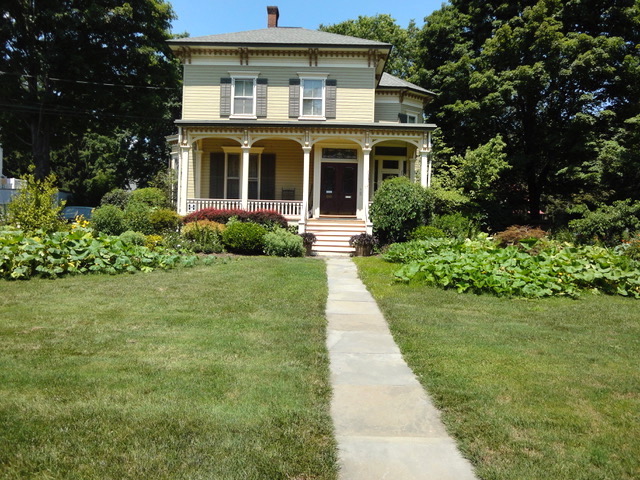
In my Rhinebeck neighborhood – the residential streets of the historic district – two-story houses with a basement, attic, small front and large backyard are common.  The most important houses often anchor the corners, with the exception of Chestnut Street with its grand houses and very deep setbacks.  The largest houses in the village probably sold off surrounding land at one time, the only remaining evidence being the occasional adjacent barn.

A House On Chestnut Street
Livingston Street is a typical mid-19th century village street.  A scattering of houses – some earlier, some later, some modest, some more affluent – line both sides of the street.  The houses may differ, but most lots are uniform. They are long rectangular plots, the house set close to the street, perhaps a barn, shed or garage tucked in the rear.  Because this pattern was ubiquitous in the mid-to-late 19th century, there is a body of literature both of the period and later to guide our thinking.

We started with the earliest 19th century designer of houses and landscapes, Andrew Jackson Downing. His books – A Treatise on the Theory and Practice of Landscape Gardening, Victorian Cottage Residences, and The Architecture of Country Houses – were enormously influential as the primary texts for the design and landscape of Hudson River country homes.  

Downing's Victorian Cottage Residences

      
A Grand Italian Terrace

The landowners employed architects and builders, and their craftsmen learned new techniques and styles.  Craftsmen and artisans employed in the creation of these gardens soon modified and reproduced them for village houses and began to work for village homeowners of wealth and substance. 

Downing’s ideas eventually filtered down to owners of the smallest village houses.  He would have had an even greater influence had he not died in 1852 at age 36 in a fire on a river steamer, leaving the field clear for Olmsted and Vaux.
       
Today, Downing is best known (and well loved) for Victorian Cottage Residences, first published in 1842 and succeeded by several editions.  It became a guidebook for owners of small village residences, laying out in detail how the properties should be used, down to specific planting plans and maintenance expectations of family members. 

The ornamental part of the garden would lie in front of planted trellises, with the working garden discretely in the rear.  The vines he recommended for covering the trellis are ones we still use today: several varieties of honeysuckle, clematis, wisteria and roses.  His lists of suitable trees, shrubs and flowers would still serve today’s gardener well. 

A Downing Plan for a Village Garden

The kitchen garden was hidden behind the trellis.  Downing knew that the more common vegetables could be purchased as cheaply as they could be raised and recommended growing only the earliest and most delicate fruits and vegetables strawberries, asparagus, peaches – and devoted less than one-third of the area of a standard lot to the kitchen garden. 

In the early 19th century people of means bought their plants from nurseries, but many households depended on traveling salesmen.  Flower agents used to canvas country towns from house to house.  Sometimes they came with a catalog, but often they had only a single plant.  Chinese wisterias and fringetrees were sold this way, as were clematis jackmanii, which could be seen to adorn porches up and down the block.  In Concord, Thoreau recalled a certain rhododendron sweeping his village, sold to all by a single agent. 

Downing was a proponent of bedding masses of low-growing flowers in patterns – a distinctly Victorian preference, now almost completely abandoned. You might still see it at classic racetracks like Belmont, where the bedding concept was in full force as annuals stayed in place for the duration of the racing season.  

My first professional job was at Belmont, where I marked up huge rolls of plans with an X in color for each of the thousands of red, white and blue petunias which would then be grown in vast greenhouses in preparation for the June planting. 

In the literature of village gardens, nobody superseded Downing until the1920’s when Fletcher Steele started writing about the small garden.  As with Downing, this was not Steele’s primary work; he was a designer of very grand gardens with a distinct turn towards modernism.  The stunning Blue Staircase at Naumkeag alone is worth a trip to the Berkshires.  

The Blue Staircase at Naumkeag

His wonderful 1924 book Design in the Little Garden positions the home garden as a withdrawal from the outer world. Seclusion is the first and most important of garden qualities; unlike Downing, Steele believed it was not possible to live at ease in a front yard.  He could not conceive of anyone bringing a book and a rocking chair to a front porch.  

Steele would be puzzled by the uses of front porches today and its public quality. In some Rhinebeck houses the steps of the porch is a like a city stoop; it is an invitation to stop and chat or a place to sit and watch the world go by.  The raised porch however implies a degree of privacy; if you see a neighbor reading a book you would not be inclined to disturb her. 

Gail and I were captivated by Design in the Little Garden; the example Steele uses could have been lifted straight from Livingston Street.  He creates a fictional block, Maple Cove Avenue.  Three imaginary houses, Numbers 11,13, and 15 are set on uniform lots, 75’ x 125’, but the landscape in each is treated differently.  
            
Design in the Little Garden

They each incorporate the necessities of the time: a garage sometimes in the front, sometimes in the back at the end of a long driveway; privacy; a drying yard; space for vegetables and fruit; an assortment of porches in front and/or back; some lawn with hedges and flower borders.  No. 13 has a formal garden, No. 11 an informal garden and No. 15 an example of what not to do – the house set far back and too much of the lot opened widely to public view.  Each house has its lessons about what works and what doesn’t.

A Dooryard Garden

The front dooryard garden, almost an anachronism today, was a staple of early gardens.  In colonial times the dooryard garden was always fenced and gated.  It was carefully cultivated and enclosed the most prized flowers.  Starting with early narcissus there were always a few red and yellow single tulips, followed by phlox, the only native American plant.  The most glorious was often the early red ‘piny’ as peonies were then (and sometimes still) called.  

There might be a few shrubs, a lilac and perhaps viburnum.  By the 19th century spirea and deutzia had arrived from Japan as had flowering quince and cherries.  Almost all these flowers can be seen in gardens today, but the spireas and deutzias have fallen out of fashion.  In a dooryard garden like the photograph above, plants were left growing in one spot for a very long time eventually shouldering one another aside like children growing up in the same family. 

Small gardens everywhere in the world are almost always hospitable. They are domestic in scale and tailored to the needs and wants of the owners.

This was our goal for 71 Livingston Street.  If there was an early garden here, all traces of it were gone. It was a bare plateau with only a few of the easiest of plants to grow – hostas and daylilies.  The maples and black walnuts planted at the time the house was built in 1865 remained on the perimeter.  This was all we had.  We started with a clean slate.

Sunday, September 2, 2018

Designing The Garden

 Over the years my gardens have tended to look alike.  I have my favorite plants and use them so often they have become that hated word -- my ‘signature.’

To cast a fresh eye I asked Gail Wittwer-Laird to join me on this garden.  An academically-trained landscape architect with a few years in the gardens of Italy, an adventurous eye and endless patience, she is my perfect partner.  No detail was too small to fuss over.

To begin, our base map was a standard block and lot plan available from any municipality.  Then we did our ground-truthing -– checking to see that the information was accurate.  Gail began by measuring, photographing and laying out a plot plan with the major features correctly located.

The Side Yard, Before We Started

The back yard was a blank slate, used in the past only as a dog run, the dogs kept safe and deer kept out by a 5’ tall hog wire fence.  It was in deep shade, a row of black walnuts to the west, Norway maples to the east. The most beautiful aspect of the site is the way the light filters through the black walnuts, dappling most of the garden.  As with many great beauties, deception lies at her heart.  In this case, the black walnuts became an intractable problem, turning the prospective garden into a war zone as the walnuts came crashing down in their late-summer season.

From the beginning I wanted a simple, elegant plan for the garden, somewhat formal in character and in keeping with the flat rectangle we were given.  But the longing for simplicity was muddled by my early use of three different areas for sitting.  
 
The First Sitting Area
The first was a sunny spot on the western property line, directly under the walnuts.  The second spot, also under walnuts, was at the rear of the property in front of a recovered bed.  The third, walnut-free, was under the Norway maples on the eastern property line. The most important sitting area, off the kitchen, did not yet exist.  It was a doormat of small concrete slabs, wet with runoff from the roofline, also under walnuts.

As for our program, there were no activities to accommodate, no vegetables to harvest, no sports, no water, no play equipment, no sandbox, no swing set.  Visiting children could play hide and seek, find treasure with metal detectors, ride bikes on the street, or hold tea parties.

For terraces, we experimented with a series of pods determined by the need to move around the garden as the walnuts grew and threatened to fall: function over form. But given our predilections we chose form over function and settled on an axial pattern – aesthetics over utility.   

We Start The Terrace

We started with a 22’ x 15’ paved rectangle off the rear of the house, and a false perspective created by narrowing the brick-edged beds as they moved towards the back of the garden.  A firm horizontal line running from the center of the house straight through to the rear of the garden kept us on course.

One of the decisions firmly set from the very beginning was the focus on a large lawn.  There is nothing quite as calming as a long, cool, green lawn, and in my dreams I saw protective borders, portable chairs and table, arbors and croquet sets, a writer's hut at the bottom of the garden – all very Virginia Woolf.  But if a lawn is to invite you to linger, it has to be intimate, to have a sense of enclosure.  Unless you are blessed with a river or a lake you will have to build your own enclosures – buildings, walls or shrub borders.

The Lawn at Bellefield in Hyde Park

This key decision was – to be polite – counterintuitive.  Some might even say misbegotten.  Most gardens today are planned to remove as much grass as possible minimizing both labor and water consumption, then planted bed by bed, pocket by pocket as the mood strikes.  We held onto the idea of a long, wide swath of lawn, and developed the garden as a single encompassing design, visible from the moment you enter. 

A large panel of lawn – or a green garden -- is no different than others in the need for privacy and a bit of seclusion. We started at the boundary lines and worked inward.  Our borders are generously deep, larger on the east border than the west as our carefully plotted centerline when laid out did not divide the property equally.  Nonetheless our borders are generous enough to mask the discrepancy on the east, while opening up the views worth capturing on the west.

Gail and I talked and plotted and planned and sketched for almost a year before we put the plan out to bid.  Our goal was to install the woody plants, the trees and shrubs, in the fall of 2015.  The herbaceous material would wait for the following spring.

Plans flew back and forth courtesy of Autocad and UPS.  The design was completed and priced down to the last detail before a shovel hit the ground. This was a process Gail and I were both familiar with, having worked on public parks together.  Now the process was scaled down to an average building lot.

After more than two summers daydreaming and a year planning, work began.  By the end of 2015 the beds were planted and edged in brick, gates and friendly fences appeared, a terrace was set, an arbor and trellis were added, an old well house shored up, a table and chairs delivered.

A Corner of the Garden Today

Although I live alone I am not the sole arbiter of this garden. There is large cast of opinionated contributors: Gail Wittwer-Laird, landscape architect and longtime colleague; Natalka Chas, planting designer who had worked for years on my prior garden; Dennis Gendron of Twin Brooks Gardens, our principal contractor; Delfino Martinez, master stonemason; Brian Tamm and Dan Frank, superb carpenters, and Daniel Horne who takes care of the garden as if it were his own. 

As all gardens do, this one ranges back and forth in time through past gardens and considers why we build gardens, the importance of place, why we long for calm green spaces, what we see in them, their poetry and their place in the imagination.  And always the season ahead; the conviction that if you plant bulbs in the fall you will be here in the spring to see them bloom.