Sunday, August 19, 2018

From Brooklyn To Rhinebeck

Last week I worked on two posts at the same time -- one on my first garden in Brooklyn, and the second on the Rhinebeck garden.  I was well into both when I realized that the two neighborhoods were almost identical in character, despite being separated by 100 miles and 75 years. 

In 1943, the country was deep into the Second World War and our family on East 9th Street was no exception. I grew up on this leafy street in Brooklyn with an extended family in a big house with a front yard and a back yard, and from the beginning of the war until the end the back yards were turned into Victory Gardens.  We all became gardeners.

WWII Victory Garden Poster

During the war years almost all farm food production went to the armed forces, and so we started to grow our own. Children were fully mobilized for the war effort.  We made rubber band balls (for what end we never knew), we made silver balls from the foil in our parents’ cigarette packages (for what use we never knew), we harvested our vegetables and pulled them in wagons to wherever we were supposed to deliver our crops.  In our games we became heroes and spies, hiding in the spaces between garages, jumping off roofs to safety, decoding secrets and saving lives. 

WWII Era Service Flag

Every house on our block had a flag in the window with a blue star for each person in the service.  We children were The Blue Star Brigade, selling 10cent War Savings Stamps door to door, pulling our wagons behind us.  We were sheltered from the worst; there were no gold star families on our block.  Everyone came home.

At the war’s end the front and back yards returned to their old patterns. The front yard had the expected azaleas, while the back yard was a square plot of grass bordered by neighboring garages.  We had laundry lines and three plant varieties in narrow beds: a red climbing rose on a small arbor, green and white hosta – our school colors -- and the money plant, sporting silver dollar-like seed pods.  

Lunaria, The Money Plant

The back yards were not for sitting. If you sat outside in good weather it was on the walk running from the front steps to the sidewalk, or on the steps themselves.  We played board games on the steps or ball games in the street.

Seed-starting and beginning botany occurred in school, where we set seeds in wooden cream cheese boxes discarded by the appetizing stores.  In those years cream cheese was sold from the box, by the slice, and everyone started their seeds in these boxes -- a perfect size for deep, schoolroom windowsills

My inner garden life, as so much else, started with a book.  At age 6 I was given Honey Bunch: Her First Little Garden.  I didn’t covet her garden, only her garden apron.  It had four pockets – one for a ball of string, one for scissors to cut the string, one for pencil and paper to make note of what she wanted to plant, and the last for a tape measure to lay out her rows.  

"Honey Bunch: Her First Little Garden" - Published in 1924

My childhood copy was long gone, but I when I started this blog I tracked down an early edition.  No wonder I loved it; I looked like the little girl on the cover – curly blond hair, a navy blue dress with white rickrack, a little red wheelbarrow.  

The book covered every task a child would need to start a garden, ably assisted by family and neighbors.  It had a strong supporting cast: a doting uncle who supplied tools, a devoted father who taught her everything, a mother who kept the household running, a mischievous boy next door, a best friend and, most significantly, an elderly woman in a wheelchair who gave Honey Bunch her late husband’s secret snapdragon seeds, which at book’s end won her First Prize in the garden show.

Many years and many gardens later, I’ve fetched up on Livingston Street in Rhinebeck, another quiet street lined with large Norway maples entering their decline.

Livingston Street

After years of gardening on top of an isolated mountain on the other side of the river, I wanted to live in a house on a block with neighbors, sidewalks, and streetlights.  What I didn’t see then was that without deliberate consideration I had recaptured the street of my childhood, the quiet neighborhood, the familiar faces, the sense of home.  

The inescapable difference is that there are no young children on Livingston Street.  On East 9th Street most households were, like mine, multi-generational.  On Livingston Street there are visiting grandchildren and that’s about it. But one hopes.

I rented #71 for a few years, and when I was finally able to buy the house the garden came first.  I was years behind my self-imposed schedule, and so the garden was fully conceived, planned and installed with mature plants in a single year.   It would be the last in a long line of gardens I have owned, worked in, and written about. 
       
Before We Started

Next Post: The Rhinebeck Garden Begins: Nuts and Bolts.

Sunday, July 22, 2018

In Praise of Small Pots

       A garden large enough for even a brief stroll brings more to the eye than I can absorb or record in a single stroke.  In my garden, 120 feet deep, a walk with a notebook ends with at least two pages of notes. Six astilbe here, plus a few more ferns filling in nicely there, a crowd of hellebores at the corner, and so on. 

I tend to see the Big Picture and overlook the Small.  But last year a visit to Pondside Nursery introduced me to the pleasures of tiny plants: thrift, miniature daisies, carpet tulips.  Something is always happening in even the tiniest of pots, a single blossom to be removed, a decision between pinching back to encourage fullness or prolonging the life of a single brave cosmos. 
       
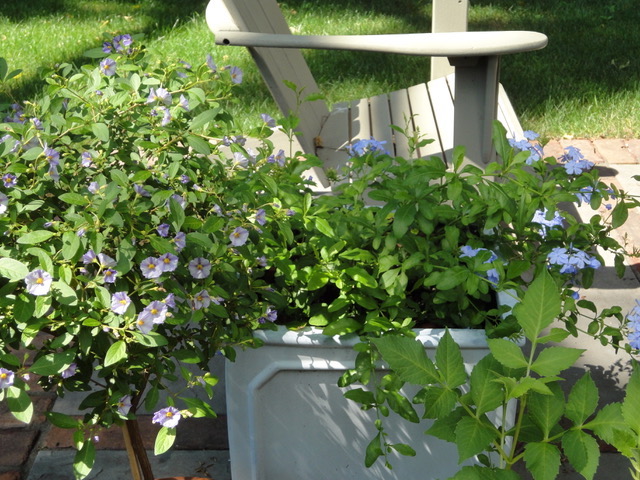
Plumbago with Unidentified Companion

To keep up with an inventory of small pots my day starts early – up at 6:30, one double espresso with milk, and then the watering starts.  I use an elegant watering can, a pleasure to carry, the gift of two gentlemen gardeners. I prefer it to a hose; although it requires walking to and from the kitchen sink it provides marginally more exercise than standing still with a hose on “mist.”

I have another system if I must be away for a few days.  I water well and leave saucers filled with additional water under every pot, save the biggest.  Everyone fusses over root rot, but I’d rather risk that than death by drying out.

The Beginning of the Terrace Pot Garden

My terrace inventory so far: One dahlia, one plumbago, 4 oxalis, 2 helichrysum, 1 calocasia, 1 alocasia, 1 nemesia, 2 tiny blue unidentified South African plants.  These are augmented by a few larger pots, a mandevilla “Alice DuPont” (soft pink and not garish), and one hefty palm.

Mandevilla 2018

“Alice Dupont” was the first mandevilla to appear on the market.  Named for the owner of Winterthur, I found it in their gift catalog in the early 1990’s. I bought two, one was left in a sunroom where it climbed to the ceiling, through the roll-up bamboo blinds and was left there, dead, for at least a decade. The other mandevilla went to Saretta Barnet where it was well watered and climbed to her second story deck. This is a photograph of me standing next to it. 

Mandevilla 1992

Indoors, I have two myrtle topiaries in the smallest of pots, switching their locations every two weeks.  One is in a sunny window; the other on the mantelpiece in a deep interior room.  Two weeks in the sun and two in the dark seem to work well enough so that the plants don’t notice the change.  At the time of the switch-over they get minimal haircuts to trim their neatly rounded shape.

Sunny Beech Street Verge

Every day on my morning walk to the Mobil station to pick up the NY Times, I pass a sunny verge on Beech Street planted with pots of marigolds, cleome, tomatoes and odds and ends that need more sun than the homeowner’s backyard offers.  I have no such sunny verge on Livingston Street; my trash yard is the only place bright enough for annuals.  It was formerly home to garbage cans, old tools, and broken chairs.  It is now a gravel piazzetta, and houses to plants deserving more sun than I can offer elsewhere – zinnia and cosmos (flowers of childhood and my early gardens), pots of kitchen herbs and, the occasional odd experiment, this year nigella.

The Piazzetta

I’ve always planted pots with a single variety as opposed to elaborate mixed pots. If you pot up one variety to a container you can group them anyway you like, changing heights and relationships by placing a few on inverted pots.  I have only one mix – a rectangular zinc container at the front door.  It’s always a palette of green and white  caladium or a variegated-leaf geranium, bacopa and scutellaria.

Complex arrangements of three or more varieties in a pot with a strong architectural presence is fine in a house with a strong architectural presence, or lining restaurants and shops where you need to make a statement that will draw customers in.  Bread Alone in Rhinebeck is a fine example of this. Natalka Chas does all the flowers and seasonal pots, inside and out, in Rhinebeck and their other locations. She is a master of the combination of scale, design and variety. It’s worth dropping by.

If you want to experiment with complex pots, the most deliriously ambitious book on pot gardening is Ray Rogers' "Pots in the Garden". There is so much you can take from it, even if you only want a sprig or two. (Timber Press, Amazon, $18.90 new.)

In my heavily shaded garden I’m ruthless with colors that don’t work and have even been known to cut back the flowers of hostas. In pots enjoying a bit of sun I’m more forgiving. With my morning coffee I can sit alongside an unidentified blue flower in an old Guy Wolfe pot on an even older lichen-covered stone table and do what I seem to do best -- stare off into the distance, ostensibly thinking.

An Unidentified Morning Companion

---
Correction:

Yesterday's reference to the Winterthur catalog should have read "early 1990's", not "early 1900's."  I would not have been around to see it in the early 1900's.  Thanks go to Joseph Kaufman, a careful reader in Jerusalem.

Sunday, July 1, 2018

How Does A Garden Start?

Ideally, you study a site, consider the exposure, assess the light levels, analyze the soil, and factor in your lifestyle and the needs of your family. In reality, you find a house, indulge your desire for tomatoes (even though you don’t have enough sun, and will not be around to water), satisfy your lust for climbing roses (even though you don’t have enough sun for this either, nor do you have anything for roses to climb on), and then you stumble through a few years of expensive mistakes.
A clematis happier than it's companion rose. 

In my most recent garden – and I expect my last – I was saved from some mistakes because I was a renter before I became an owner.  What I was willing and allowed to undertake was limited.  A little tinkering with an existing bed was about it.  When I approached my landlady with the desire to make an ambitious garden, she offered to sell me the house instead.    

From the garden’s standpoint, I had the advantage of having spent several seasons just staring and imagining.  An excellent practice if you have a few extra years.  The design of the garden evolved slowly with the help of skilled artisans and practitioners, but that is the subject of another post.   What is useful to know at this point is that over many years and several gardens I have established a few rules for myself, some honored and others honored only in the breach.

Rule 1:  Respect your neighbors and the neighborhood. You will not have this to consider if you own a large property with no neighbors or are in the middle of a forest.  But if you are in a village or on a block with sidewalks and neighbors, whatever you do should be compatible in style and feel with whatever is going on next door and down the block.  You may not like it, but deal with it kindly.  Don’t build walls and plant dense hedges.  Try something soft and seamless; a mixed shrub border works well.  Or arbors and trellises will soften something you wish to see less of, without obliterating your neighbor.

Be aware of the effect of your street-side planting, its relationship to the house, passersby, and the rest of the block.  I am not happy with my work in this department, and instead of figuring out a good solution I am wandering around the neighborhood looking at front yards that are drearier than mine.  Below is an example -– a very grand house surrounded on all side by gloomy, thorny, unkempt crabapples.

A screen planting helping neither the house nor the street. 

Rule 2:  Take your time.  Give careful thought not to what you want your garden to look like, but how you want to live in it.  Do you want to have your morning coffee outside the kitchen door?  Do you want to hide out in a corner of the garden where no one will find you?  What do you want to see from your favorite vantage point?  I have fought all comers to hold on to a particular view from the kitchen table, through a glass door and up into towering walnuts.  All I want is more of the same – larger glass panes, thinner door frames, more to see.

Rule 3:  You will be gardening in a hostile environment, no matter how benign it seems. Be prepared and stay strong. There will moles or voles, squirrels or rabbits, hail storms or droughts, endless rainfall or none, strange mold and fungus, leaf rollers, mysterious viruses, odd disappearances and occasional resurrections.

Rule 4:  Try and hold on to something of the past, of the gardeners who have been there before you. Whether it’s the flowers they planted or the tools they used, save and continue to use and nurture what you can. 

A forgotten, purely decorative well house. 

When I arrived on Livingston Street my neighbor Marian Faux already had a flower border on the narrow panel dividing our properties. Over these few years we doubled it and then doubled it again, pushing the margins of what will tolerate only partial sun and black walnuts.  It has at last, in its fourth year, “come into its own.”  By this I mean Marian and I have become more accepting of its limitations.  

Rule 5:  No matter how much you are prepared to spend, it will cost more.

Given all this, why do we even start a garden? Why do we persevere? Pick any summer day, and you will have your answer.

Sunday, May 27, 2018

The 2018 Season

Every year between winter’s end and spring’s beginning I am sure that nothing in the garden will return;  that only disappointment will result from all the effort, the care, and the planning.  Then I remind myself that the point of having a garden is to believe if you plant bulbs in the fall, you will be around to see them bloom in the spring. 

So where does it come from – this conviction that all will be lost? Is it the sin of hubris, the price of overweening ambition combined with the guilt of overspending in the preceding year?  Fortunately, it’s only the anticipation that is bleak; the reality is that we are having a robust early spring in 2018.  

        This is the third year for the garden.  The old saying -- that the first year the garden sleeps, the second year it creeps and the third year it leaps –- is true.  It is only late May and I’m beginning to run out of room for growth. 

Creeping phlox, meadow rue and hydrangea.

        The ferns, astilbes, hellebores and hostas are spreading out.  The creeping phlox is beginning to lose its bloom but will probably hold on for another week.  The Spring Green tulips are beginning to ebb, but they have been in bloom more than two weeks.  The cimicifuga has spilled over its allotted areas.  

Hosta, fern, cimicifuga and sweet woodruff.

        The aronia is blooming along the driveway.  The bearded iris are opening and the Siberian iris and peonies are getting ready to take over next.  I have no complaints.

Aronia in the Driveway

        We did have some significant losses this past year.  The worst was the death of four of the six Japanese maples central to the design of the garden.  They succumbed to verticillium wilt, a fungal disease caused by soil-borne pathogens that clog the vascular system of the plant.  Die-back occurred section by section either slowly, or in my case, from one weekend to the next.  Leaves appeared to curl and shrivel, and suddenly a major branch was dead.  Once stricken, the tree must be removed and the soil is forever contaminated.  

The Last of the Japanese Maples 
        
        So now we are faced with two limitations: susceptibility to soil damaged by verticillium wilt and the toxicity of the surrounding black walnut trees. By the time you vet for both these conditions you are left with few choices.  Dogwoods (which have their own regional problems), conifers (too dark and heavy for me) apples, and Sweetgum. The Sweetgum (Liquidambar styraciflua) won out despite a prickly seed production that puts black walnuts to shame.  

        The Sweetgum is a beautifully-shaped tree with a spreading canopy that can reach 75 feet.  It gives the garden a park-like look as opposed to the domestic, garden-esque feel of the Japanese maples.  They will need background and understory planting, but I’ll worry about that closer to fall.  In the meantime I’m looking at their tiny leaves, and making sure they have enough water to open up.

        As to the perennial walnut problem, this year I am trying Snipper, a de-flowering agent that will eliminate the blossoms but does not affect the foliage. Used by growers with large plantations of nut trees, the agent is inoculated around the perimeter of the tree.  This is an uneasy route for me to take, but given the staggering cost of the other possible solutions it is worth a try.  

Sunday, February 11, 2018

Planning For Spring

Catalog Covers
The overstuffed mailbox or the reassuring thud at the front door means that the spring garden catalogs have arrived.  They may not be harbingers of the season, but they will definitely help dispel winter’s gloom.

I’m far enough along in my own garden now to be able to resist wanting everything I see or read about, regardless of site orientation, sunlight, or zone suitability.  I now accept that I have only one partially sunny border and a backyard bordering on a hostile environment –- deep shade compromised by black walnut trees.  For the record, a new villain has been added. Verticillium wilt has killed off 4 of my 6 key Japanese maples, limiting the plant palette even further.

A brief sidebar here: verticillium wilt is a fungal disease caused by soil-borne pathogens.  There is no cure, and a stricken plant dies quickly, one large section at a time. There are only a limited number of plants that can be used in infected soils, and our maples have been replaced with sweet gums.  But more on verticillium wilt later; this post is supposed to cheer the reader.

Back to the catalogs: some of the best nurseries are now Online Only.  As fine as they are, these are not my favorites. I am a print person and like to carry my catalogs around, sitting or lying down whenever the mood strikes me, and marking them up as I go along.  But for those of you happy to look at tiny pictures on your iPhone, don’t miss Digging Dog Nursery.  It is among the most user-friendly: easily understood icons, plus a drawing of a camera leading you to a photograph when there is one available.  I’m ordering from them for the first time this year.

In the past I’ve bought as much as I can from our local nurseries, and with excellent results.  I have no complaints.  But when your garden is as small as mine, and with many site restrictions, the gardener tends to look further afield for more varieties to try.  That’s when the nuance of a really good catalog grabs you by the throat.

My current favorites are Roots and Rhizomes, Bluestone Perennials and Brent and Becky’s Bulbs; the last because it was the favorite of a much admired gardener on Staten Island, Muriel Peters, who specializes in daffodils.  

Roots and Rhizomes takes the award for the most beautiful cover design –- a garden in itself.  It specializes in daylilies with more than 160 photographed and described; it is a dream for the daylily collector.  I am not one, but instead have ordered several Siberian iris, a stalwart in my garden.

Bluestone’s list is wide and deep.  Twenty agastaches, 14 fall anemones, a few bergenias and brunneras, more than 30 clematis, 28 coreopsis, and I’ve only worked my way through the C’s. Skipping ahead, I found hollyhocks available in single colors instead of the usual offering of mixed colors in other catalogs.  I’m planning on yellow and black for my only south-facing fence.

I remain loyal to White Flower Farms because it was a first love. I always order a few things, although I find the catalog confusing and jumbled.  The nursery was started in the late 1940’s by William Harris and his wife Jane Grant, both journalists in New York City but weekenders in Litchfield, Connecticut. Their passion for gardening eventually became a small business in a time when American gardening was non-existent as an industry, and when there was virtually no interest in new plants or garden design.  They published a small, highly readable catalog under the pseudonym of Amos Pettingill to distinguish this work from their mainstream careers.  The nursery was sold in 1976, following Ms. Grant’s death, to Eliot Wadsworth, whose family I believe still runs it today.  This year I ordered a bi-colored honeysuckle to add to the arbor. 

Logee’s catalog is for the northeastern gardener who has run out of things to do and plants to try and is willing to take a risk on tropicals.  A Massachusetts gardener I know well grows banana trees outdoors, carrying them up two flights of stairs when the cold weather sets in to give them a warm room.  I am not going that far, but I am rethinking my side trash yard as a piazetta.  It borders on delusions of grandeur but I don’t think it will be extravagant enough to qualify as certifiably delusional. This fall I brought in my few oxalis and one lone plumbago which was glorious during the summer.  This year I will order a few more tropicals and think seriously about the possibility of wintering them in the basement.  Unfortunately I don’t have a greenhouse or a sunroom, only the relatively inhospitable basement. But maybe with growlights and a timer…

If you garden only in the shade, eat your heart out over David Austin’s Handbook of Roses 2018. He lists a few that are suitable for less than full sun, but does not offer an old rose, Betty Prior, which I remember with love and longing but can’t seem to find anywhere. 

Of course, in the end, the quality of the nursery lies not in the catalog but in the material delivered.  If the material does not arrive in good condition no finely designed or beautifully photographed catalog can make up for disappointment.  I’ll report back on deliveries, successes, and failures as the season progresses.  In the meantime, take your catalogs as the best medicine to get through a long winter. We can always dream… and order.