Sunday, May 9, 2021

The Season Opens

In mid-April, as we look to the trees for leaf buds, it is the ground layer below that comes in first.  Early each morning I pace the perimeter of the garden marking the minute daily changes. The trees and shrubs are halted, but the ground layer slowly advances day by day.  The early daffodils were first, then the phlox, bleeding heart, the sole apple tree, the amelanchiers, all seemingly at once.  Each week the hydrangeas are a little taller, the gillenia leafier, the iris and peonies beginning to stretch. Epimedium, seemingly devastated by the late frosts, bloomed as ever.  Color returned on time, blue phlox, rosy bleeding heart and the pale white of the late daffodils.


Phlox subulata


The kitchen table is filled with plants bought too early to set outdoors. The oxalis, all four pots wintering indoors, are flagging and desperate for division, new soil, a change of containers, fresh air.  The beefsteak begonia, started from a single rooted cutting last summer, is bursting out of its pot.


This year I didn’t bring the mandevilla indoors to winter over.  It is (was) the hard-to-find Alice Dupont so each year I would struggle to have its huge pot dragged into the warm house for the winter. This year I left it outdoors, wrapped it in fleece, and hoped for the best.  I tried to grow a new mandevilla from a leaf cutting of the old, and while the mandevilla did not comply a nasturtium seed traveling with it sprouted in the kitchen window, grew towards the ceiling, has flowered, and is now ready to move outdoors.  Sometimes a kitchen table and a windowsill will be enough to get you through a long winter.  


As for the mandevilla left outdoors, its fleece covering did not work and there is not a sign of life.  The colocasia bulbs stored in the basement were other failures of this winter’s experimentation and are shriveled beyond resuscitation. Now the hard work starts. Moving the big pots, filling them again with new plants to try out, planting morning glory and nasturtium seeds outdoors. 


Mandevilla 2020


I think about earlier gardens this time of year.  I have stored up all of them, able to summon them at will and imagine myself in them again.  Who was there with me?  How old was I then?  Will I be in this garden forever?  I never thought to ask if the garden would be there forever.  


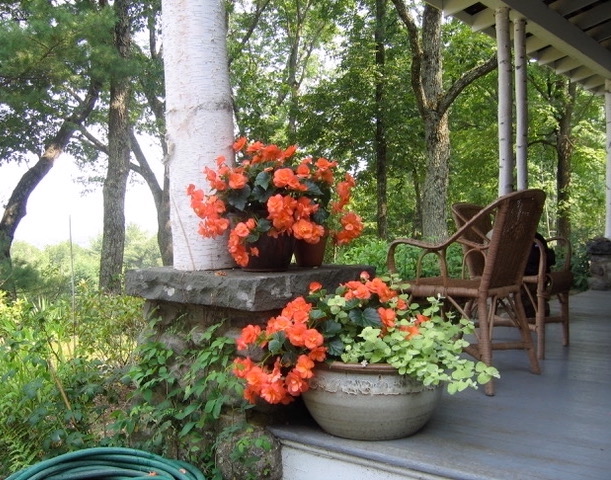
I’ve often said that a garden dies with the death or departure of the owner, but occasionally it is a catastrophe that threatens it.  A tornado, a great Northeastern storm, or a fire. The main house in my former Catskills garden caught fire last month.  No one was there, no one was injured, only the history is gone.  Although only one end of the house is charred, the rest is no longer structurally sound and must be demolished.  Miraculously, the gardens remain relatively undisturbed. The porch garden planted in 2005, and the excavation of an old border across the way, all survived.  The long porch itself with its sweeping view of the reservoir, its roof held up by birch trunks, will remain in use propped up like a stage set while the current owners decide on its replacement.


A Corner of the Porch


The main house, 1918 shingle style, was the repository of stories and events of one extended family’s time there over the past 70 years.  No longer the home of the Laissez-faire Gardener and myself, it has been passed on to cousins with children in their early thirties, who have the strength and the vision to build for their future families.  The spirit of the place will be demanding for the new architect.  Sited amidst a stone tower with a revolving observatory on the top, a bowling alley house and a huge stone pool long a habitat only for frogs, the new house will surely reflect the context of the old.


My visit there was not the tragedy I expected it to be.  No longer bound to serve as keepers of the shrine they inherited, the young stewards and their partners are looking towards the next chapter.  Those who would have been devastated by the fire have long since passed.  Only the strong remain, as it should be.


Before The Fire


Thursday, August 6, 2020

Why Parks Matter

Parks, Public Spaces and Neighborhoods

     Should I even have to make this declarative statement?  Don’t we all know the reasons?  Health and well-being data abound, economic benefits are not a secret.  There is no shortage of information for this argument.  

Infrequently made is the argument that parks are the great social equalizers.  No one is turned away.  There is no charge to get in.  This cannot be said for the cultural institutions:  museums, concert halls, theatres, opera houses.  There is an admissions charge, often steep for a family, excluding many from the benefits of a great city.  Only our libraries are equally free; you just have to be able to sign your name to a library card.  Six is about the right age.  

Riverside Park

But we have many more parks than cultural institutions in New York City.  We have 2300 – more than our fair share.  But the parks are not in the neighborhoods where the needs are greatest.  The flagship parks – Central, Riverside, Flushing Meadows-Corona, Prospect, Van Cortlandt, are easily accessible only to those living close by.  In these times subway and bus travel is hazardous at best.

“If you are looking for a neighborhood in New York City with no parks,” says Adrian Benepe, former NYC Parks Commissioner and now Senior Vice President at the Trust for Public Land, “look for a neighborhood with the word ‘park’ in its name:  Ozone, Rego, Borough.”  These neighborhoods, built solely by developers, added the word ‘park’ to lure buyers into thinking they would be moving into a park-like setting.  At the height of the pandemic, when the playgrounds were closed, 1.1 million New Yorkers did not have access to a park within a 10-minute walk from where they live, according to the Trust for Public Land.

To remedy the economic consequences there is a frantic scramble to transform commercial outdoor space.  On-street parking has given way to outdoor dining or restaurant pick-up in a bid to help restaurants and coffee shops survive.  The Center for New York City Affairs projects that 2020 could end with 500,000 to 600,000 fewer jobs than the beginning of the year with half of that jobs deficit stemming from face-to-face industries – restaurants, local retail, neighborhood services and entertainment.  Many of these changes have been made with no civic engagement and while they are amenities in affluent neighborhoods it doesn’t play the same way in less-affluent neighborhoods.  

The coronavirus and its disproportionate effect in low-income communities and on people of color has forced planners to change the way we look at public space.  It has opened our eyes of the glaring inequities of access to parks.

Governors Island 

A case in point: Governors Island.  It reopened with a new ticketing system making it easier for visitors from underserved areas.  Management already knew that most visitors came from Brooklyn Heights, Park Slope and the Upper West Side and was catering to that demographic until pushed into thinking more broadly when the pandemic hit.  Now ferry tickets will be free to public housing residents and the ferry stop to the island from Brooklyn Bridge Park has been moved to Red Hook, the location one of the city’s largest public housing projects.

Parts of Queens are woefully underserved.  In Rego Park a schoolyard behind PS139, one block wide and about as long, is mostly paved.  The few places to sit are on the edges of raised planting beds. This schoolyard is only a block or so away from a heartbreaking missed opportunity, the proposed QueensWay. 

An elevated linear park on the old rail line, QueensWay would transform a long-abandoned rail line running from Rego Park south to Ozone Park. The project, around for nearly a decade. pitted parks proponents against commuters who wanted to reconstitute the rail system, discontinued in 1962.  The debate awaited resolution in an MTA study, completed in 2018 but held back a year for release.  The study revealed the cost of rail service would be between $8 and $10 billion, sticker shock for the transportation supporters.  

Outdoor Classroom in the Proposed QueensWay

In addition to the expense, QueensWay remains politically sensitive.  It is dead at the moment, but not yet buried.  Parks proponents could not get city money to build it, nor private money (unlike the High Line) and it was sidelined due to bureaucratic inertia and lack of vision.  Nonethless, the combination of the cost to rebuild the rail system, the coronavirus lockdown, the inequities of park distribution and the looming threat of school closures should be enough to raise the call to revive QueensWay.

Supporters received a boost when the Queens Chamber of Commerce, long a proponent of improved rail service, came out in support of the park project.  Now it is up to the Mayor to provide preliminary funding.  Notoriously unfriendly to parks, he has not initiated any new parks in his administration; it will take public pressure or the next administration to push this forward. 

This is only a snippet of what city residents will face as schools try to figure out whether and/or how they plan to open.  Hybrid arrangements of half-time in school, half-time at home are being discussed everywhere.  Although there were frantic emergency measures to expand locations for health care at the height of the pandemic in New York City, the same sense of urgency is not evident regarding education.  The bureaucracies have yet to look at the potential of moving classrooms out of doors.

Parks and Schools

     While the Board of Education struggles with parceling out limited indoor space among 1 million students, the use of outdoor space for classrooms is beginning to garner attention.  It started with the press, graduated to candidates for office, and is rumored to be a rumor in the Mayor’s office. 

Ginia Bellafante in the New York Times (July 9th) and Adrian Benepe of the Trust for Public Land were among the first to see the possibilities of outdoor space for education.  Ms. Bellafante reminded readers of the tuberculosis outbreaks in the early 20th century, when school attendance was out of the question.  Open-air classrooms were run year-round on school rooftops and abandoned ferries.  Within two years of the first opening, 65 open-air classrooms were mobilized.  

Early Outdoor Class - circa 1915

We know the risk of contracting the virus diminishes out of doors.  But this fact hasn’t entered into the calculations of the city’s bureaucracy.  Mark Levine, City Council member who has chaired both the Health and Parks Committees, makes the case that “there is an emerging public health consensus that minimal transmission occurs out-of-doors, making the idea of outdoor classrooms a logical step.” 

Currently, New York City has the nations’ largest school system with more than 1 million students.  Children are not the only ones at risk.  There are more than 75,000 teachers plus an army of support personnel and security staff.  Empty office spaces and vacant buildings without windows that open are not the answer.

At hand we have the network of city parks, ideal for mobilization as outdoor classrooms.  The Parks Department response is expected.  “Everyone asks the Parks Department to do more with less funding, the liabilities at stake are not considered, nor are the laws defining use.” 

Covid Tents in Central Park

But we do have precedent in times of crisis.  After the 1906 earthquake in San Francisco tent cities went up in Golden Gate Park.  In the 1936 heatwave Mayor LaGuardia advised New Yorkers to sleep outdoors in the parks.  Central Park provided space for a tented field hospital during the worst of the pandemic, using standards developed and perfected in World War II, for Covid tents.  Why not do the same for schools?  Linear parks like Riverside and Ft. Tryon transect an economic range of neighborhoods.  Riverside Park, engaged in a capital campaign to rethink the North Park, stretches six miles along the Hudson.  It would not be too difficult to identify sites for outdoor classrooms.

As with parks, public schools are also free but not necessarily equal.  Schools in affluent neighborhoods have a relatively low density and are close to major parks.  Those in the poorer parts of the city are not.  We will probably see wealthy school districts (and private schools) able to raise new money to rent additional space and achieve social distancing, while poorer school districts will have to “make do” with what they already have.

And what about the neighborhoods with no parks of any consequence?  The case for outdoor classrooms has been led in large part by Adrian Benepe of the Trust for Public Land, whose mental inventory is the repository of most of the available spaces in the city.   

In the 1940’s and 50’s Robert Moses created 275 jointly operated playgrounds.  Between 8am and 4pm the playgrounds were operated by the schools and after 4pm by the Parks Department.  There are now close to 600.  New York City and the Trust for Public Land, between 2007 and 2013, converted more than 250 schoolyards for student and community use.  NYCHA has 700 playgrounds, and many have other open spaces and enclosed lawns.  

1940s Jointly Operated Playground 

The Parks Department has 35 Recreation Centers with gyms and bathrooms.  There are 600 community gardens, some large enough to accommodate classrooms.  The Natural Areas Conservancy manages 10,000 acres of natural areas within the New York City parks system, ideal sites for science classes.

Every new schoolyard has learning gardens.  Many schools have sports fields.  There are scores of community centers, gyms, and outdoor recreation centers sitting vacant.  There are west side cruise ship piers, and piers used for art fairs, if the sides can still be raised.  The City University has campuses.  So do Stuyvesant Town and Peter Cooper Village.  St. Catherine’s Park, adjacent to the old Julia Richman High School building (now home to four high schools and a middle school) has a two-acre asphalt field. 

St. Catherine's Park

Maybe it’s time to look at Transportation Alternatives troubled but innovative Open Streets Program and apply its best ideas to schools.  Adam Ganser, Executive Director of New Yorkers for Parks, said “It might be possible to close some streets adjacent to small schools during school hours” and hold classes outside instead of sending kids home.  This could also work at the high school level.  The almost block-long Julia Richman building on 67th Street has only the New York Blood Center across the street.

Other than the months in which the playgrounds were closed, 99% of New York City residents lived within a 10-minute walk of a park, according to the Trust for Public Land.  But what is the density within that 10-minute walk?  Single family houses, two-family houses, apartment towers?  How many people are actually using that park?

Thus we arrive at New York’s baseline message:  Everyone should be no more than a ten-minute walk to a park.  I respectfully suggest amending that to a five-minute walk.  Heresy to the ten-minute proponents, but ten minutes is a bit of a stretch to a person pushing a stroller, or a wheelchair, or managing your own wheelchair, or trying to hurry a curious toddler, or maneuvering a walker, or using a cane, or having trouble breathing.

Paley Park

Or maybe it’s time to buy blocks of buildings to create new parks.  We have done better and worse in the past.  Paley Park was built on a sliver of land at 3 East 53rd Street, the site of the Stork Club.  It opened in 1967, occupying 1/10th of an acre, and has been in constant use ever since.  So has Greenacre Park on East 51st Street.  And you only need one building site each for these.  At the other end of the spectrum, an entire neighborhood was destroyed to build Lincoln Center.  We won’t do that again, but maybe it’s time to look at many small parks instead of the mega-parks it has been so fashionable to build.

We need creative and courageous solutions in these unprecedented times.  We saw an exodus of the affluent, leaving behind under-served communities most impacted by the pandemic and without the escape valves of neighborhood parks. 

Unfortunately, you won’t see any new thinking in the present administration.  No new parks have been started under Mayor DiBlasio, only continuation of the parks started during the Bloomberg Administration.  And the Teacher’s Union is likely to stand in the way of moving classrooms outdoors, or any innovative idea.  The work will fall to the next administration.  Scott Stringer, City Comptroller, in an op-ed in the Daily News calls for an examination of outdoor education possibilities.  I expect we will see more of this in the coming weeks.  

All it takes is a few people of courage and vision.  But the charge for innovation in dealing with classrooms needs leadership immediately and right now the group is small.  Where are the levers of change here? I doubt the Mayor will entertain this.  The City Council could force it through legislation, but that is unlikely.  The strongest voices could come from parents speaking up in an organized fashion; elected officials cannot help but respond to the collective voice of the Community Boards and the Community Education Councils.


A wave of resolutions could appear before the City Council in a matter of weeks, if mobilized by the Borough Presidents. Leadership, courage, and vision matters.

I can be reached via E-Mail at:  morrisoncatherine3@gmail.com

Tuesday, August 4, 2020

Why Parks Matter, Part 2

Parks and Schools

     While the Board of Education struggles with parceling out limited indoor space among 1 million students, the use of outdoor space for classrooms is beginning to garner attention.  It started with the press, graduated to candidates for office, and is rumored to be a rumor in the Mayor’s office. 

Ginia Bellafante in the New York Times (July 9th) and Adrian Benepe of the Trust for Public Land were among the first to see the possibilities of outdoor space for education.  Ms. Bellafante reminded readers of the tuberculosis outbreaks in the early 20th century, when school attendance was out of the question.  Open-air classrooms were run year-round on school rooftops and abandoned ferries.  Within two years of the first opening, 65 open-air classrooms were mobilized.  

Early Outdoor Class - circa 1915

We know the risk of contracting the virus diminishes out of doors.  But this fact hasn’t entered into the calculations of the city’s bureaucracy.  Mark Levine, City Council member who has chaired both the Health and Parks Committees, makes the case that “there is an emerging public health consensus that minimal transmission occurs out-of-doors, making the idea of outdoor classrooms a logical step.” 

Currently, New York City has the nations’ largest school system with more than 1 million students.  Children are not the only ones at risk.  There are more than 75,000 teachers plus an army of support personnel and security staff.  Empty office spaces and vacant buildings without windows that open are not the answer.

At hand we have the network of city parks, ideal for mobilization as outdoor classrooms.  The Parks Department response is expected.  “Everyone asks the Parks Department to do more with less funding, the liabilities at stake are not considered, nor are the laws defining use.” 

Covid Tents in Central Park

But we do have precedent in times of crisis.  After the 1906 earthquake in San Francisco tent cities went up in Golden Gate Park.  In the 1936 heatwave Mayor LaGuardia advised New Yorkers to sleep outdoors in the parks.  Central Park provided space for a tented field hospital during the worst of the pandemic, using standards developed and perfected in World War II, for Covid tents.  Why not do the same for schools?  Linear parks like Riverside and Ft. Tryon transect an economic range of neighborhoods.  Riverside Park, engaged in a capital campaign to rethink the North Park, stretches six miles along the Hudson.  It would not be too difficult to identify sites for outdoor classrooms.

As with parks, public schools are also free but not necessarily equal.  Schools in affluent neighborhoods have a relatively low density and are close to major parks.  Those in the poorer parts of the city are not.  We will probably see wealthy school districts (and private schools) able to raise new money to rent additional space and achieve social distancing, while poorer school districts will have to “make do” with what they already have.

And what about the neighborhoods with no parks of any consequence?  The case for outdoor classrooms has been led in large part by Adrian Benepe of the Trust for Public Land, whose mental inventory is the repository of most of the available spaces in the city.   

In the 1940’s and 50’s Robert Moses created 275 jointly operated playgrounds.  Between 8am and 4pm the playgrounds were operated by the schools and after 4pm by the Parks Department.  There are now close to 600.  New York City and the Trust for Public Land, between 2007 and 2013, converted more than 250 schoolyards for student and community use.  NYCHA has 700 playgrounds, and many have other open spaces and enclosed lawns.  

1940s Jointly Operated Playground 

The Parks Department has 35 Recreation Centers with gyms and bathrooms.  There are 600 community gardens, some large enough to accommodate classrooms.  The Natural Areas Conservancy manages 10,000 acres of natural areas within the New York City parks system, ideal sites for science classes.

Every new schoolyard has learning gardens.  Many schools have sports fields.  There are scores of community centers, gyms, and outdoor recreation centers sitting vacant.  There are west side cruise ship piers, and piers used for art fairs, if the sides can still be raised.  The City University has campuses.  So do Stuyvesant Town and Peter Cooper Village.  St. Catherine’s Park, adjacent to the old Julia Richman High School building (now home to four high schools and a middle school) has a two-acre asphalt field. 
 
St. Catherine's Park

Maybe it’s time to look at Transportation Alternatives troubled but innovative Open Streets Program and apply its best ideas to schools.  Adam Ganser, Executive Director of New Yorkers for Parks, said “It might be possible to close some streets adjacent to small schools during school hours” and hold classes outside instead of sending kids home.  This could also work at the high school level.  The almost block-long Julia Richman building on 67th Street has only the New York Blood Center across the street.

Other than the months in which the playgrounds were closed, 99% of New York City residents lived within a 10-minute walk of a park, according to the Trust for Public Land.  But what is the density within that 10-minute walk?  Single family houses, two-family houses, apartment towers?  How many people are actually using that park?

Thus we arrive at New York’s baseline message:  Everyone should be no more than a ten-minute walk to a park.  I respectfully suggest amending that to a five-minute walk.  Heresy to the ten-minute proponents, but ten minutes is a bit of a stretch to a person pushing a stroller, or a wheelchair, or managing your own wheelchair, or trying to hurry a curious toddler, or maneuvering a walker, or using a cane, or having trouble breathing.

Paley Park

Or maybe it’s time to buy blocks of buildings to create new parks.  We have done better and worse in the past.  Paley Park was built on a sliver of land at 3 East 53rd Street, the site of the Stork Club.  It opened in 1967, occupying 1/10th of an acre, and has been in constant use ever since.  So has Greenacre Park on East 51st Street.  And you only need one building site each for these.  At the other end of the spectrum, an entire neighborhood was destroyed to build Lincoln Center.  We won’t do that again, but maybe it’s time to look at many small parks instead of the mega-parks it has been so fashionable to build.

We need creative and courageous solutions in these unprecedented times.  We saw an exodus of the affluent, leaving behind under-served communities most impacted by the pandemic and without the escape valves of neighborhood parks. 

Unfortunately, you won’t see any new thinking in the present administration.  No new parks have been started under Mayor DiBlasio, only continuation of the parks started during the Bloomberg Administration.  And the Teacher’s Union is likely to stand in the way of moving classrooms outdoors, or any innovative idea.  The work will fall to the next administration.  Scott Stringer, City Comptroller, in an op-ed in the Daily News calls for an examination of outdoor education possibilities.  I expect we will see more of this in the coming weeks.  

All it takes is a few people of courage and vision.  But the charge for innovation in dealing with classrooms needs leadership immediately and right now the group is small.  Where are the levers of change here? I doubt the Mayor will entertain this.  The City Council could force it through legislation, but that is unlikely.  The strongest voices could come from parents speaking up in an organized fashion; elected officials cannot help but respond to the collective voice of the Community Boards and the Community Education Councils.

A wave of resolutions could appear before the City Council in a matter of weeks, if mobilized by the Borough Presidents. Leadership, courage, and vision matters.

I can be reached via E-Mail at:  morrisoncatherine3@gmail.com

Monday, August 3, 2020

Why Parks Matter, Part 1

Parks, Public Spaces and Neighborhoods

     Should I even have to make this declarative statement?  Don’t we all know the reasons?  Health and well-being data abound, economic benefits are not a secret.  There is no shortage of information for this argument.  

Infrequently made is the argument that parks are the great social equalizers.  No one is turned away.  There is no charge to get in.  This cannot be said for the cultural institutions:  museums, concert halls, theatres, opera houses.  There is an admissions charge, often steep for a family, excluding many from the benefits of a great city.  Only our libraries are equally free; you just have to be able to sign your name to a library card.  Six is about the right age.  

Riverside Park

But we have many more parks than cultural institutions in New York City.  We have 2300 – more than our fair share.  But the parks are not in the neighborhoods where the needs are greatest.  The flagship parks – Central, Riverside, Flushing Meadows-Corona, Prospect, Van Cortlandt, are easily accessible only to those living close by.  In these times subway and bus travel is hazardous at best.

“If you are looking for a neighborhood in New York City with no parks,” says Adrian Benepe, former NYC Parks Commissioner and now Senior Vice President at the Trust for Public Land, “look for a neighborhood with the word ‘park’ in its name:  Ozone, Rego, Borough.”  These neighborhoods, built solely by developers, added the word ‘park’ to lure buyers into thinking they would be moving into a park-like setting.  At the height of the pandemic, when the playgrounds were closed, 1.1 million New Yorkers did not have access to a park within a 10-minute walk from where they live, according to the Trust for Public Land.

To remedy the economic consequences there is a frantic scramble to transform commercial outdoor space.  On-street parking has given way to outdoor dining or restaurant pick-up in a bid to help restaurants and coffee shops survive.  The Center for New York City Affairs projects that 2020 could end with 500,000 to 600,000 fewer jobs than the beginning of the year with half of that jobs deficit stemming from face-to-face industries – restaurants, local retail, neighborhood services and entertainment.  Many of these changes have been made with no civic engagement and while they are amenities in affluent neighborhoods it doesn’t play the same way in less-affluent neighborhoods.  

The coronavirus and its disproportionate effect in low-income communities and on people of color has forced planners to change the way we look at public space.  It has opened our eyes of the glaring inequities of access to parks.

Governors Island 

A case in point: Governors Island.  It reopened with a new ticketing system making it easier for visitors from underserved areas.  Management already knew that most visitors came from Brooklyn Heights, Park Slope and the Upper West Side and was catering to that demographic until pushed into thinking more broadly when the pandemic hit.  Now ferry tickets will be free to public housing residents and the ferry stop to the island from Brooklyn Bridge Park has been moved to Red Hook, the location one of the city’s largest public housing projects.

Parts of Queens are woefully underserved.  In Rego Park a schoolyard behind PS139, one block wide and about as long, is mostly paved.  The few places to sit are on the edges of raised planting beds. This schoolyard is only a block or so away from a heartbreaking missed opportunity, the proposed QueensWay. 

An elevated linear park on the old rail line, QueensWay would transform a long-abandoned rail line running from Rego Park south to Ozone Park. The project, around for nearly a decade. pitted parks proponents against commuters who wanted to reconstitute the rail system, discontinued in 1962.  The debate awaited resolution in an MTA study, completed in 2018 but held back a year for release.  The study revealed the cost of rail service would be between $8 and $10 billion, sticker shock for the transportation supporters.  

Outdoor Classroom in the Proposed QueensWay

In addition to the expense, QueensWay remains politically sensitive.  It is dead at the moment, but not yet buried.  Parks proponents could not get city money to build it, nor private money (unlike the High Line) and it was sidelined due to bureaucratic inertia and lack of vision.  Nonethless, the combination of the cost to rebuild the rail system, the coronavirus lockdown, the inequities of park distribution and the looming threat of school closures should be enough to raise the call to revive QueensWay.

Supporters received a boost when the Queens Chamber of Commerce, long a proponent of improved rail service, came out in support of the park project.  Now it is up to the Mayor to provide preliminary funding.  Notoriously unfriendly to parks, he has not initiated any new parks in his administration; it will take public pressure or the next administration to push this forward. 

This is only a snippet of what city residents will face as schools try to figure out whether and/or how they plan to open.  Hybrid arrangements of half-time in school, half-time at home are being discussed everywhere.  Although there were frantic emergency measures to expand locations for health care at the height of the pandemic in New York City, the same sense of urgency is not evident regarding education.  The bureaucracies have yet to look at the potential of moving classrooms out of doors.  

"Why Parks Matter, Part 2" takes this on.  More to come...

I can be reached via E-Mail at:  morrisoncatherine3@gmail.com
Saturday, July 18, 2020

Wildife and Water

Friends who live outside the village and further out in the country than I are busy trapping beavers and racoons (or hiring trappers to trap).  I operate on a more domestic scale.  If you were reading this newsletter in 2017 you will remember the Squirrel Wars.  They are over, in large part because the squirrels won.  My current enemy are ants, in assorted shapes and sizes.

Ants have been around almost since the dawn of time, appearing in fossils around the world.  They are a vigorous species with several nasty varieties in residence in the northeast.  Several have been with us since the 18th century, brought to the US as so many other infestations, in the soil-based ballast used in ships and then deposited ashore to make room for goods bought for return to Europe.  

Pavement Ant

The ants devasting my paving are, as you might expect, pavement ants Tetramorum caespitum.  They can be identified by two nodes in front of their abdomen and fine grooves on their head and thorax.  If I had small children in residence I would have put them to work trapping the ants, arranging for their deaths and then examining them under a microscope.  But having no children to conscript I’ll stick to the evidence the ants leave behind.

The tiny ones emerging from the joints between the brick and bluestone on the terrace behind the house bring large sandhills with them.  At least I thought they were sandhills until my veterinarian daughter reported that what I see as sand is in fact ant poop.  The day I noticed them I had at least 50 mounds to deal with and the number grew. 

An Ant Hill

Consulting Google produced an assortment of home remedies from planting mint, to a 50/50 solution of vinegar and water, to lemon juice, to red pepper, to boric acid and then on to various commercial ant control products.  I chose the boiling water technique, pouring directly into their homes either cooking them or drowning them.  When the hills dried I swept them up only to find reconstruction underway 12 hours later in the same locations. 

Desperate, I called in an exterminator, Pestmaster, who informed me that the situation at the front of the house was even worse than the back, rife with members other ant families:  black and carpenter.  The treatment was applied (Demand CS) and after 3 weeks the paving joints can be sealed.  

Once you decide on this path you can’t turn back.  Pavement ant colonies have multiple queens and many workers.  They swarm in May and June sending winged ants that are twice as large as the workers out of the nest to mate and form new colonies.  In this manner countless queen pavement ants have been fertilized by the tiny male pavement ants, one-third the size of the queens.  You can only destroy an infestation by destroying the colony and killing the queen. If the queen survives the colony will break up and migrate elsewhere.

No matter how much of an irritation the enemy may be, first squirrels then ants, when you study their lives, habits and social structures, a grudging admiration sets in and you find yourself rooting for their side in the determination to multiply and survive.

Now, believing the enemy to be vanquished, I can enjoy the rest of the wildlife.  Jamie, my garden helper, had a palm warbler settle down next to his feet while he was weeding, and it has since paid a return visit.  Wrens have taken up residence in the wren house – a small black box nailed to the old well house.  A thoughtful gentleman in Connecticut I’ve never met made the house for me, after being asked by a friend of a friend.  

The Wren House

There is a lot of in-and-out activity, what with nest building, feeding and visiting back and forth.  I don’t go near the boxes for fear of disturbing the babies.  

The birds seem to hang around more since I have stepped up my watering practices.  I have an efficient if primitive non-automated watering system.

When I first built this garden, a simple rectangle (114’ x 56’) now in its fourth season, I installed one water line along the length with hose bibs every 40 feet.  I keep a 50’ hose permanently attached to the bib with a circular sprinkler head similarly attached at the other end so there is no annoying detaching and reattaching.  The hoses are coiled at the bib and left hidden at the back of the shrub border.  All it requires of me is that I pull a hose out, set it in place and turn it on.  I move it hourly, each hour covering 8 to 10 running feet, depth variable.  It takes about two days to cover all areas – that’s about 24 zones, give or take a few. 

Watering Underway

This may sound formidable, but it is actually calming.  First, the time it takes to move a hose is less than five minutes and the process keeps you from leaving the house for more than an hour at a time. This provides hours and hours to read, write, nap, return phone calls, bake cookies, think about dinner. Or if you just choose to sit and stare, the result of all this watering is a deep, cool, green garden that catches whatever breeze is passing by.