Tuesday, May 8, 2012

May Calendar


A few general notes are in order before we get to the calendar. April was so confusing; the unseasonable warm spells followed by harsh cold snaps have thrown the plant community off kilter. You have only to visit your hydrangeas to see the muddle: new leaves, blasted and blackened buds, dead stalks.

Your borders will be showing all its losses and gains by now, and so the spring rush of transplanting will soon be underway.  Remember not only to water well when transplanting, but also to provide sufficient moisture for the roots during their first year in a new location.  Don’t let more than one dry week go by without watering. 

Cornus Kousa, the Asian Dogwood
Before you start digging in and become consumed in the rush, take a few hours (or days) off and look around. The flowering dogwood (Cornus florida) may be seen everywhere this month.  Its cousin, the Asian dogwood, (C. kousa) will be less evident in our local gardens.  Blooming a month later than its ubiquitous cousin, the creamy white or pink blossoms growing on horizontal branches are a stately addition to the garden.  It is unsurpassed as a lawn tree, so keep your eyes open for one. 

When the lilacs bloom you know it is safe to plant dahlia tubers outdoors. Plant your supporting stakes at the same times, at a depth of two inches, as the dahlia heads will need all the support they can get.  When the stems are a foot tall, tie them to the stakes.  Your dahlias will grow anywhere from 18 inches to four feet, depending on your selection. 

This is a good time to visit your local nursery’s collection of tropical and semi-tropical plants.  Bougainvillea or Mandevillea will be wonderfully showy on a terrace or a porch.  They can always be taken indoors to winter over, if you have the patience.      

House Plants Ready for their Summer Vacation
You can start to move your indoor plants outside for their annual summer vacation, but only if you are prepared to whisk them back indoors should the temperature drop precipitously.  I usually wait until Memorial Day as the safest time, unless an early-May visitor can be dragooned into carrying the biggest pots.  

Some gardeners move their houseplants to a shaded location for a few weeks, and then to a location that will give them more light. I keep mine in a shaded location during the summer, as the fresh air and rainfall are enough of a vacation.  As your houseplants will most likely be in small pots, you will have to be meticulous about watering and fertilizing, but you will notice fewer pests outdoors than in.  

If you are planning to repot, now is the time to do it.  Move up one pot size, root prune if necessary, and cut back the top growth in proportion to what you have cut from the roots.  Reshape the plant now rather than in the fall.   

This is the time to get ahead of weeds.  If they are just emerging you can rake them up, but if they have grown to six inches you will need a hoe to pry them loose.   Just be sure to get them out before they go to seed or you will never get ahead of them.   I promise that if you are meticulous about weeding and mulching early in the season, you will be rewarded by a relatively easy summer.

Wet the soil well before you pull up weeds as you will have less disturbance than if you worked on bone-dry soil.  This is a good practice before planting too.  Water to a depth of one inch before planting, and water well again after planting.  You don’t want to drown your new plants, but you certainly don’t want them to dry out.

Take a walk in the woods.  Deep in the forest Carolina allspice, or Sweetshrub (Calycanthus florida) will be showing it’s dark brown-red flowers.  This is the month for woodland wildflowers; make notes about what you would like to see in your own shady edges. 
Carolina Allspice
In the garden, as the lilacs and bleeding hearts fade, bearded iris will take center stage.  The first peony will show itself by the end of May: the red “Memorial Day piney.” It will bloom reliably on time, but the bearded iris will continue to hold the stage for two or three weeks until the rest of the peonies come along.  


WEEK ONE
Keep your gift plants indoors until the nights are consistently warm. 
Prune forsythia and other spring- flowering shrubs whenever the blooms are finished.  
If the soil is not sticky, sow seeds of hardy vegetables and flowers. Make sure night temperatures are steady at or above 55F.
You might be able to keep pansies blooming through early July by picking off the dead blossoms so that seeds will not form.  If they are planted in a shady spot for part of the day, they will bloom even longer.
Lavender


If you are growing lavender, prune it back hard to encourage new growth. 
Cut back Russian sage, leaving just six to twelve inches of woody growth.  Pinch out the tips of new growth to encourage a bushier form.
If you see ants on peony buds, leave them in peace; they are harmless.

WEEK TWO
Peonies

If you want bigger peonies or roses, now is the time to disbud.  You will have fewer flowers, but bigger individual blooms.  Leave the terminal bud, but pinch off the side buds just below it to limit the number of flowers. 
Nights are still too cool to move houseplants out of doors, but you may move tropicals outside if night temperatures are steady at or above 55F.
As pansies die out, replace them with edging lobelia or sweet alyssum.
When lilacs bloom you can plant dahlias out of doors.
Weeds will soon start to overtake flowers.  Don’t pull them out of dry soil; water the garden first.
Order summer-blooming bulbs this month.
Spring gardens are peaking now –- public and private.  Visit as many as you can and take notes. 

WEEK THREE
All pinching and disbudding of perennials should be completed by now.
Container Plants on a City Terrace


You may set out container plants, but if a late frost is predicted be prepared to cover them with a protective cloth.  It’s best to be patient and wait until Memorial Day. 
Seeds of perennials and biennials for next year’s bloom may be sown now through August.
It’s time to sow annual seeds directly in the soil.
Put peony rings in place before it is too late. There’s a moment at which you can longer do this without damaging the plant.
Cut the deadwood from climbing roses.
Start planting perennials and herbs.                                                             

WEEK FOUR
Start transplanting seedlings. Work on a rainy or shady day if you can.  If not, water frequently and protect them from the sun. 
Ring clematis with lime and dig it into the soil.
Mark the locations for next years’ spring flowering bulbs by placing plant markers.  Don’t cut bulb foliage down until it yellows.
Order bulb catalogs, if they have not yet arrived.  
The Unrivaled Common Lilac


Consider the lilac. Observe as many as you can, then make your choice.  The hybrids are gorgeous, but my favorite remains Syringa vulgaris, the common lilac. 
Continue planting perennials and herbs.
Where spring bulbs have left gaps, sow seeds of zinnia, cosmos and cleome.
Water everything well.  If we don’t have a good rain every seven to ten days water planted beds slowly to a depth of at least an inch. 
Buy a rain gauge and set it out in the open.  It will save endless discussions.
Move house plants outside to their summer camp – a nice spot in the shade.
Song birds will have returned by now.  Help them build their nests by leaving six- to eight-inch pieces of string on the branches of shrubs or lying on the ground along with dead twig ends and they will be collected quickly. 
This is the time to look carefully at the Bearded Iris and identify the ones you would like to order.  Better still, find a friend who is ready to divide.


Monday, April 16, 2012

Spring Ephemerals and Beyond

Henry James said that the two most beautiful words in the English language are “summer afternoon.” But when you see this photograph of Riverside Park taken April 2, it gives you pause.  
I cast a vote for the words “spring ephemerals.”  The phrase doesn’t have the resonance of long shadows and leisurely days, but it means what it says.  Spring ephemerals are fleeting.  You will find them in the woods, generally low to the ground, and they are beloved of gardeners who are out and about with the first breath of mild air.  They need the sunlight and the active pollinators that are present only before trees reach full leaf.  They appear in early spring, and vanish within six to eight weeks.
Among the earliest of the spring flowers are the Trilliums.  Called wake-robins because they begin to bloom at the same time as the return of the red robin, they are among the loveliest of the woodland flowers.  Trilliums are beautiful as a single plant, but they are an astonishing sight when you come across them in large drifts.  They are generous spreaders, so a large drift is not too much to hope for when planting.  
Trillium

There are about 30 Trillium varieties native to North America, and they are immediately recognizable as they all share a distinguishing feature -- the arrangement of three leaves, a single stem, and a single flower at the top.   You will find them for sale in bulb catalogs, as they are tuberous plants. 


Jack-in-the-pulpit (Arisaema tryphyllum) makes a bold entrance into the landscape, emerging from the forest floor on a single, sharp, pointed spike.  The leaves slowly unfurl, revealing a hooded enclosure, the spathe, and the rounded shape of the preacher “Jack,” which is then covered by the hooded “pulpit.”  They are impossible to overlook.

If you are fortunate enough to have a patch of woodland, plant the wild geranium (Geranium maculatum), a close cousin of the sanguineum hybrids much admired in sunny borders.  In the light shade, with its pink flowers and slightly loose habit, it is beautiful in combination with its wildling cousin, the columbine (Aquilegia  canandensis). The geranium will form low mounds along the ground, while the columbine blooms on stems up to two-and-one-half feet, emerging from a mound of green leaves.  Flowers can be yellow or red, and will bloom for almost a month.

Many of the ephemerals will spread to form a groundcover.  Dwarf iris (Iris verna var. smalliana), can be used to particularly fine effect tucked in the crevices between large rocks.  Growing no more than six inches tall, it will spread wherever there is room.   
Woodland phlox (P. divaricata) lasts too long to be characterized as ephemeral, but is too beautiful to exclude.  In early spring it blankets the woodland floor with sky-blue blossoms.  Phlox slowly seeds itself about an area; individual plants grow into one-foot mounds, quickly forming a carpet of blue that lasts for several weeks. 

Shooting star (Dodecatheon media) shows its tall clusters of white flowers atop single stems.  Planted among ferns, it serves as a striking focal point.  The foliage dies down and disappears in the summer, which will go unnoticed in a woodland garden.

For some reason, we seem to see more yellow ephemerals than any other color.  Perhaps we notice them because we long for the sun.   Green-and-Gold (Chrysoginum virginianum) blooms richly with a profusion of yellow, daisy-like flowers.   It does so again in the fall. 

Golden ragwort (Senecio aureus) is a rapid spreader, creating colonies of golden flowers rising above heart-shaped leaves.  It is happiest in moist soil in sun or partial shade, thus a good choice for the woodland edge of a streamside.  Heartleaf Golden Alexander (Zizia aptera) is another healthy spreader.  Usually seen only in mid-western prairie gardens, its resistance to drought, heat, biting winds and severe winters make it a winner in the northeast. 

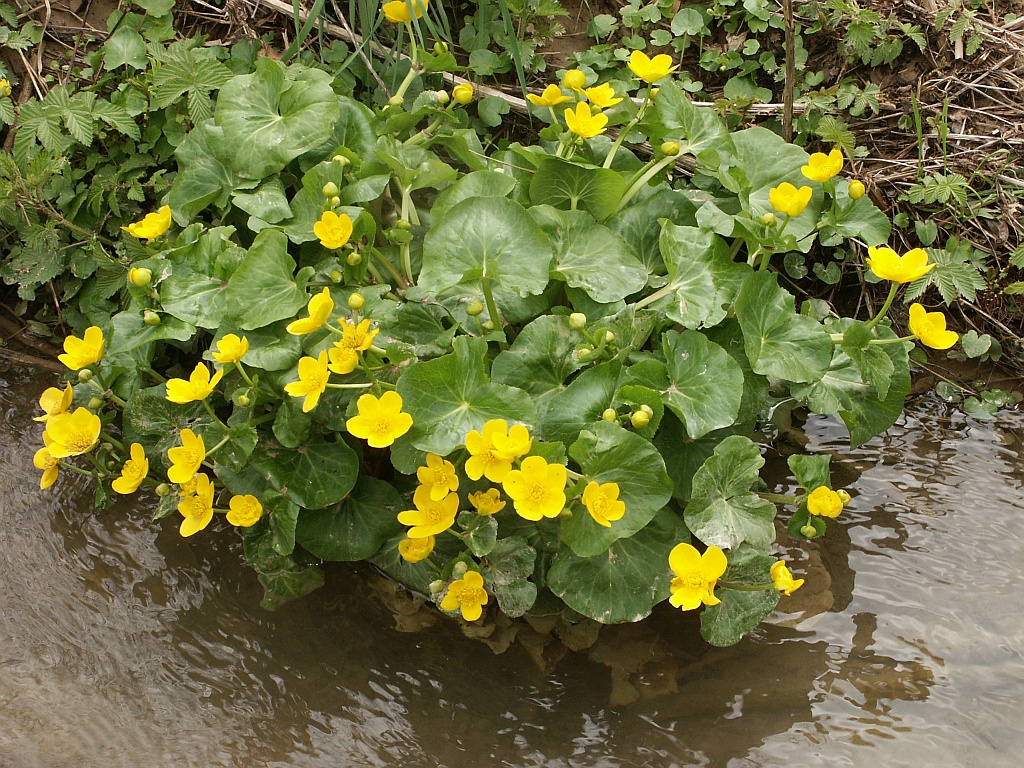
On the wet side, the Marsh marigold (Caltha palustris) blooms in a rich yellow when there is no other color around.  It is usually found streamside where the downstream flow of water carries it along, allowing it to colonize on the banks.  Their areas tend to increase on their own, and if you look closely you will find tiny tubers scattered over the surface of the soil.  
Marsh Marigold
One of the beauties of a woodland garden is that unlike cultivated borders you can forget about something once it has disappeared and not pay attention to the area until the following year, when you will enjoy the resurgence all over again.  For now, when walking in the woods, keep your eyes on the forest floor.  It’s there that you will find the tiniest and the most fleeting of the ephemerals.

Monday, April 2, 2012

April Calendar

Now that we are in full battle dress for the gardening season, it’s time for the return of the Monthly Calendar.  Print it out, post it on the refrigerator door, or in the potting shed, should you be so fortunate.
M. stellata. The end of the earliest blooming variety of Magnolia.

The close of March put a serious knot into everyone’s plans. The extraordinary heat pushed many plants into an early growth spurt while they were still under wraps.  Then a late March freeze made everyone nervous.  Native plants seem to fare well in unexpected turns in the weather since they respond more to light cycles than temperature, but the imports can be been fooled.

Survival of the fittest: violets in concrete.
Planting conditions are a concern; the soil is bone dry since there has been warm sun and virtually no rain.  Dazed New Yorkers are wandering around in T-shirts and sandals.  We are not off to a good start.

If you haven’t already done so, start a garden diary.  Looking back at 2011 will be informative for those of you who are already in the diary mode.


WEEK ONE
By now winter coverings should be off. Clear mulch carefully to avoid injuring new growth. Keep a few old sheets around for an unexpected frost. 
Make sure you water dry soil before turning over, but not so much that you damage the structure. 
Unwrap roses, prune deadwood, remove mulch from crowns.
Start weeding onion grass and chickweed.
Pansies along a sidewalk.


You can plant pansies now.
It’s not too late to sow sweet peas outdoors. Saint Patrick’s Day and Good Friday are the traditional days for this.  
Train vines to their supports, typing up branches dislodged by  winter winds.  Cut off bruised and broken ends.
Check shrubs for suckers and prune.  
Paint railings and steps.                                                                          
Scrub terraces and balconies.
Visit local nurseries to select trees and shrubs.

WEEK TWO

Buy new containers and tubs.  Fill with soil in anticipation of planting.

Selection of pots at Phantom Gardener Nursery in Rhinebeck.

Soak and plant second round of sweet peas.

Plant cool weather vegetables : lettuces, herbs, beets cabbages, onions and leeks.
Rake the last of the dead leaves from lawns and beds.
Hose down house siding. 
Cultivate and rake perennial borders.  Feed with                     
commercial fertilizer.

Seed the lawn.
Fertilize lawns, shrubs and roses.

WEEK THREE
Consider the gift plants.  Prepare to deal with your Easter gifts by locating a place either outdoors in the soil, or outdoors in a larger pot. 
Beware of cut-rate plants.  There are no bargains in this world.
Watch out for rabbits, chipmunks, and voles.  Look for tell-tale holes.  If you have any success in keeping them at bay, please let us know. 
Track down the little bulbs-- crocus, scilla and their kin -- and take notes for your fall orders. 
Finish dividing perennials that performed poorly last year.  
Last call to move large trees and shrubs.

WEEK FOUR
Flowering quince:
glorious blossom, hopelessly awkward form.

Prune forsythia and other spring flowering shrubs whenever the blooms are finished.  
If the soil is not sticky, sow seeds of hardy vegetables and flowers. Make sure night temperatures are steady at or above 55F.
You might be able to keep pansies blooming through early July by picking off the dead blossoms so that seeds will not form.  If they are planted in a shady spot for part of the day, they will bloom even longer.
If you are growing lavender, prune it back hard to encourage new growth.

Wednesday, March 7, 2012

The Sunday Gardener Returns

MARCH CALENDAR
No matter how mild the days, it is still too early to remove winter coverings.
Check equipment, scrub pots.
If you haven't sown seeds indoors, now is the time.
By mid-month you should be able to plant pansies.
Visit local nurseries and select trees and shrubs.
Chelsea Garden Center

Prune all but spring flowering shrubs and trees.
Leave roses and hydrangeas alone for the moment.


It’s been a long, dull winter.  No ice and snow to worry about, although March has only begun and we have been visited with March blizzards in the past.  Nonetheless, there are a few jobs that the restless and desperate can tend to.

Now is the time to turn your attention to houseplants.   March is the month when they will need more watering than they have all winter.  The days are lengthening and the plants are readying for a growth spurt.  Cut back any plants that have grown too straggly and they will send out new growth quickly this time of year.  Fear not; I have cut a huge ficus back to a hat rack and it responded beautifully.

For want of a sunny south window my houseplant inventory has dwindled to one elderly, tired oxalis.  It is an indomitable plant, surviving despite low light and too much water.  If you forget it completely, it will appear to be a total die-back but its corms will lie patiently dormant underground waiting for you to treat it well.  At the moment, the supermarkets are filled with oxalis in anticipation of St. Patrick’s Day.  Snatch them up before they disappear, because with proper care they will reward you with sprightly white flowers for years.

 There are a few tasks you can take care of in March, weather permitting.  Saint Patrick’s Day and Good Friday are the traditional days for sowing sweet peas.  Check back in our 2011 March archive “Getting Through March” for instructions. 

If your garden beds are new, test your soil and add whatever amendments are called for in the soil report.  In addition to the recommended nutrients, it’s a good idea to add compost and well-rotted manure.  Layer it on top of the beds and turn it in with a fork  or spade to a depth of about one foot.  Let it settle for a few weeks before planting.

All your seed orders should be in by now.  I have stayed with my usual sources, and you will find them listed in the Archive for February 2011, “Looking Ahead.”  
Rooftop corner with Lantana and Geranium

In the absence of the longed-for greenhouse and cold frames I still only direct-sow out of doors.  I’ve ordered nasturtiums and sunflowers, the largest assortment possible; Cleome ‘Color Fountain mix’ in pink, rose, lilac, purple and white; Cosmos ‘Sensation mix,’ the old-fashioned cosmos with white, pink and carmine flowers on 36 to 48 inch stems; ‘Heavenly Blue,’ the traditional Morning Glory; Hyacinth bean, a vigorous climber with beautiful dark green leaves and purple flowers; and Zinnia elegans ‘Benary Giant’ in the full blazing range of yellow, pink, scarlet, salmon and white, with two inch blooms on three foot stems.  This year I’m adding California poppies in the traditional orange to be planted alongside lavender; Nigella, butterfly- attracting with lovely flowers and a graceful habit; and Verbena bonariensis, tall and sturdy with rose-purple flowers.
Sunflowers and Verbena
The annuals in the Catskills do not do as well as I would like as they are grown in raised beds in a fenced-in cutting garden.  I suspect they would be sturdier and more robust out in the open.  There will be a chance to test this as it looks like I will be experimenting with a second garden.  I’ve taken a lease on a small apartment in a four-family house in the village of Rhinebeck, primarily to clear out a warehouse holding the goods of many moves.  There is a roomy shared backyard yard with one very large shade tree and not much else.  My co-tenants seem keen to garden and if we can figure out how to work around the two resident dogs we will be off and running.
Banana Canna and Companions