Thursday, July 31, 2025

Thoughts Of Home

At some point in time -- I’m not sure when but I know her boys were young --  Deborah Holmes decided she wanted to buy an apartment on the Upper West Side.  Her plan was to buy it years ahead of her need, buy it now and stockpile it for the future; she foresaw a time when she would have outgrown her loft on Broadway.  I was not yet living on the Upper West Side, so I was not the proponent of this idea.  Not did I find it financially prudent, or otherwise sound.  But for Deborah, the idea was deeply rooted in her sense of place: Where she came from, the desire to return, and the meaning of home with all its many layers of the past. 


Deborah died, unbearably young for those who loved

her, and her husband still lives in the loft that never was sold, the boys are grown and launched on their own lives, her parents dead before Deborah.  She did not live long enough to return to the Upper West Side which she believed was her spiritual home.  


I think about her now as I am living in Rhinebeck, a village with the power of place that Deborah and I talked about often -- the general well-being that comes with the sense of home.   It is an undercurrent that runs through old villages like Rhinebeck.  There are unspoken courtesies here: One is to respect the structures of your neighbors’ houses and your neighborhood.  If you live in the wider township, or on a very large property, or in the middle of a forest there is more leeway for the individuality of the homeowner.  But in an historic village, with sidewalks and immediate neighbors, whatever you do should at least bear some relationship to what is going on next door and down the block. You may not like what you see but deal with it kindly. 


The goal of this thoughtfulness is to foster the harmony that is the underpinning of a fine streetscape.  Urban planners (I count myself among them) believe the parts should fit together as a whole.  When historic districts are designated, the preservation and landmark ordinances tend to be entirely focused on the structures themselves and as a result bypass and do not curate the landscape of the front yards, trees, walks and streets that connect them.  Memorable landscapes are made when multiple properties share basic guiding principles that are enhanced and inspired by the origins that created the historic district.  


Just before writing this I was about to violate my own rule. Our block on Livingston Street has small modest houses, larger houses suitable for a sizeable family, and further down the street anchoring the corners (and occasionally mid-block) several grand houses.  


A Modest House

A Family House

A Grand House


Most have small ornamental borders against the front of the buildings, strips of lawn, then the sidewalk, then the verge holding the street trees, then the roadway.  I was about to plant a garden in that strip of front lawn bordering the sidewalk until I looked up and down the street and saw these quiet transitional lawn strips in front of every house.  I stepped back, not about to be the iconoclast who disturbed the serenity and predictability of Livingston Street (although it is entertaining to think about the effect of a little disruption).


These courtesies of course occur only in the best of all possible worlds. Without laying out guidelines it is easy to lose the very character of the streets that drew families and visitors and businesses to villages like Rhinebeck in the first place. But to codify this, a municipality risks becoming the Design Police, and residents of Rhinebeck are famously code-averse. 


The Village Board of Trustees is well-aware of these concerns and that the Village Comprehensive Plan does not take up the design of residential streets.  A plan to form a committee to address the multiplicity of issues that factor into maintaining a memorable historic district was formed but never activated.  Nonetheless, several related concerns about public safety, traffic, and drainage  -- easier concerns to advocate for than aesthetics and values – were addressed.


But the climate is changing a bit.  Those of us who follow Planning Board meetings have noticed the inclusion of landscape design in some site plans before the Board. So please -- all of you to whom these concerns matter stayed tuned and turn out when the moment comes.

Wednesday, June 11, 2025

Ponds And Bogs

The Ponds and Bogs at Altamont House, Staten Island


If you live in a village, as I do, you are unlikely to be blessed (or cursed, depending on your temperament) with stagnant pools. But if you are further out in township territory this may be a problem for you.  


What are we to do with them? You can try a windmill.  It sounds incongruous, but you see them often on farms oxygenating stagnant ponds.  If you have electricity, you can aerate by adding pumps and filters.  Or you can leave these ponds alone, providing only appropriate plants and animals that can function efficiently as oxygenators -- the practice in conservation areas.  You can then add frogs, goldfish, koi and water plants   The pond will remain clear as long as the proper balance is kept.


Although bog plants are described as needing percolating ponds and moving streams, in my years at Altamont House in Staten Island’s High Rock Park they seemed to flourish in still water.  The bogs were originally low-lying areas of meadow and woodland, but suburbanization interrupted the natural drainage patterns permanently, leaving us with self-contained bodies of water—but only during the rainy seasons.  In periods of drought the ponds became bogs, as the natural flow of water into the ocean was interrupted by the houses and roadways developed along the borders of High Rock Park in the post-war years.  


The three bog/ponds were handsome, filled with water willow and button bush and not entirely devoid of wildlife.  A mother duck, six ducklings in tow, made the trek daily from pond to pond to introduce her babies to the water.  A pair of Giant Snowy Egrets were considering it as their home base early one season, stayed around for a day or two and then headed out to find a more suitable home.


Turtles made their way out of the muddy bottom to lay their eggs in the gravel driveway.  We had to keep our eyes on the ground so that we didn’t tread on the nests.  When the eggs were laid the mothers disappeared, leaving the eggs to fend for themselves.  We marked the site with bricks and twigs so the trash carriers would notice.


Rumor has it that the resident turtles were of the snapping variety. They would usually line up in a row on a log in the middle of the bog, sunning themselves.  Snapping turtles are said to eat anything they can get their jaws around, including baby ducks, but we never saw any sign of that.  


I was encouraged enough by the behavior of our waterside plants to give them companions which were said to be equally undemanding.  Milkweed was reported to attract Monarch butterflies and BeeBalm to do the same for hummingbirds.  Large hibiscus flourished in neighboring Walker Pond and I harvested a few seeds at the end the season.  Joe pye-weed, the common skunk cabbage, cardinal flower and blue and yellow flag iris were all plants that did well with their feet in the water.


If you are determined to create a bog garden from scratch it’s best to start with a swampy, low-lying spot.  A poorly drained area that is already giving you problems can be transformed into a natural habitat filled with wildlife. The marginal plants (those that grow best in wet soils) will also tolerate periodic dry conditions as well.  Just make sure your site is away from deciduous trees so that you won’t have a leaf-removal problem in the fall.  


The instructions below give you details on just how to do this.  Read to the end before you even think of starting. Water gardens can become very seductive but if you find yourself tired from just reading the instructions below, go out and buy a big Chinese ceramic pot, fill it with water and set it in a shady spot. Add a few goldfish.  That may be just enough.


Further Notes to The Committed:  How To Build a Bog Garden


First, select your spot. Then mark the area with a string, measure it, and calculate the amount of soil that will have to be removed to achieve a minimum depth of eighteen inches. Line the hole with a plastic liner, then lay a length of perforated pipe or hose along the bottom. Seal the submerged end, and make sure the inlet connector is clear of the final soil line and easily accessible so that you can introduce water when needed.


Cover the hose with an inch or two of coarse gravel to make sure the holes don’t become clogged with all that soil you removed and now are going to replace. Before doing so, pierce the plastic liner with a garden fork every few feet. 


Replace the soil, removing all weeds and rocks along the way. Make sure the soil is good and loamy, using additives if necessary. The soil will now be higher than its previous level but will settle with watering. Give it time and don’t pack or tamp it down, or you will break up the soil structure. Once the original soil level has been reached, you can start planting.               


If your plans are ambitious, your bog garden can be associated with a fishpond, where it will act as a filter. The pond’s nutrient load created by fish wastewater can be recirculated through the bog garden, providing nutrients to the bog plants and cleaner water to the fish.

Sunday, February 9, 2025

Why Gardens Matter

Snowdrops

Years before New York City’s high line became the fabled Highline, a close friend who knew how to break into locked spaces took me for a walk along the old railroad tracks. There was something special about being the only people trudging down the abandoned rail line, spotting anything bold enough to sprout to the surface.  We both had a predilection for trespassing despite the risk to our jobs and careers. Maybe it was because the best part of our jobs offered exactly this – the opportunity be where we were not supposed to be.


In the Hudson River Valley we have similar almost--empty public spaces.  This past summer I planned to visit public gardens along the Hudson River, expecting to talk to visitors about their particular affection for their choices, only to find most of the gardens empty.  Blithewood and Montgomery Place, two grand estates now Bard College properties, were devoid of visitors on the day I came by. They were as empty as the abandoned old highline railroad tracks.  Perhaps these public gardens are busier on weekends, when visitors are more likely than fulltime residents to take advantage of them. 


For families with children a visit to a working farm would to be a better destination than the grand estates. Rose Hill is a favorite stop; fields of apples and pumpkins ready for picking, an airy barn with beautiful views outfitted with tables and chairs for dining, couches and armchairs for drinks offered by the cheery bar, and a revolving pop-up food service hosted by local restaurants and offering bargain-price dinner options.


As a child growing up in New York City we had the great public parks and botanical gardens as our backyards and ball fields.  They were carefully planned and beautifully executed to bring the best experience to the largest number of visitors. But it is the small gardens surrounding the village where I live now that matter most when everything else seems lost. 


We have been blessed in the Hudson River Valley.  Our towns and villages are not at war or destroyed by flood or fire; our plants will reappear this spring and again year after year, surviving even the possible disappearance of the host garden itself.


It is well known that there are wins and losses in everyone’s garden; it is always a battleground between the gardener’s demands and the determined behavior of the elements, the soil, and the plants themselves.  Try as you may to impose your will, the garden either accepts or rejects your efforts. The earliest spring days usually let you know what came through the winter safely and what has been lost.


My garden on Livingston Street was planned as an April garden, but when I started to return from the city earlier in the year there was not much to see.  And so in the fall of 2023 we planted hundreds of snowdrops both in the beds and the lawn; when I returned in March of 2024 there was a sea of small white blooms. But it was a gift I forgot to share with the lawn crew, neglecting to ask them to hold off on the mowing for a few weeks to let the bulb foliage ripen; bulbs gain their food supply for the following year in the ripening foliage of the current year.  Supposedly.  We shall see.  This March will be the test. 


Looking ahead to June, the hydrangeas blooming are the most glorious weeks in the garden.  I started with one of the earliest, the flatleaf arborescens White Dome. The half-sterile, half-fertile flowers have a more delicate bloom then the blowsy queen of the radiatas, the popular Annabel. The arborescens require only the most judicious pruning.  In the few warm days of February cut them back to knee-high; they will reach the perfect height by the time they are ready to bloom.  If you fall in love with the entire hydrangea family remember their bloom habits vary as will their pruning requirements – some bloom on new wood, others on old.


In 2024 the appearance of gypsy moth (renamed spongy moth) in the township sent a shudder through gardeners, but the village seems to have escaped significant damage. We are twiddling our thumbs till spring arrives.  2025 will tell all.

Friday, October 4, 2024

The Late Garden

If I could select one hour of one day as the perfect time to be in a garden it would be a Sunday afternoon at 4 o’clock.  A comfortable chair, the Sunday papers, a glass of something iced, the shadows lengthening across the lawn. All work is done, the tools are put way, older children are off doing whatever it is they do, young children are exhausted and deep into a book or device.  If they are still standing pull out a blanket, ask them to lie on their backs and tell you what they see in the trees and sky.  Dinner is under control, having been collected at a Farmer’s Market earlier in the day.  Monday morning is still far away.  The return to the office, lab, hospital, school, construction yard, or the desk in a room just indoors – all are a way off.  The present is this perfect moment – a Sunday afternoon at 4 o’clock.


The late garden is at its best now.  Brown-eyed Susan (Rudbeckia triloba) is holding its own. It’s a friendly plant, nicely shrubby, self-seeding, doesn’t overpower its neighbors, and is less attention-grabbing than Rudbeckia fulgida Goldsturm, the more popular garden variety.  The fall asters, the last blues of the season are a fine companion to the brown-eyed Susan.  I have planted Aster x frikarti ‘Monch’ although I can’t remember why this particular one.  There are many to choose from, and I suspect this was a catalog selection and not one that looked brilliant in someone else’s garden.  No matter what variety you order, if you remember to pinch them back in midsummer you will have a fuller bloom than if you left them alone.  


Crane’s bill (Geranium sanguinium Rozanne), which I seem to remember seeing in flower in the spring, is blooming in the shade of the Brown-eyed Susan.  Actea, formerly cimicifuga (and still cimicifuga to me) has passed, but the white Anemone Honorine Jobert is luminous.  Fall color is still a few weeks away, but the Black Walnuts’ yellowing leaves are drifting down – always the first harbinger of the coming cold.


It’s time to bring the pot plants indoors so they can acclimate before the house heat goes on.  The plumbago and mandevilla are enjoying their last burst before they go into the greenhouse at Cheshire Gardens in Connecticut for the winter.  The Australian tree fern and the aging lemon tree will go along with them.  I cut the beefsteak begonias back to nubs in the early spring to see how they would do and they did just fine.  Only a fraction of their former girth and now indoors, they should be happy in the warm light of a southwest window and grow to their former size by spring.  The red oxalis are back in their usual winter corners and in need of a shearing.  The small-leaved green oxalis has also made the move indoors, and it seems fine as it is.  The gift of jatropha podagrica, a stunning oddity, is in a corner with dim light and strictly minimal watering as per instructions from the giver of the gift.


Another few weeks and it will be time to put the garden to bed for the winter.  I’m planning on a heavy, compost-rich mulch which will start to break down come spring and should be enough to feed the garden. It’s been years since I laid a deep mulch so it’s long overdue.  It’s also been years since I fertilized every spring and rigorously divided and replanted perennials every three years.  Lately I’ve let them putter along on their own.  This coming year I may go back to my early practice on a few test plants and see what happens.  Fortunately for us, the plants don’t read the books.  Soon it will be time to deal with the perennials in the shared garden.  My gardening partner likes the dead flower heads left for the winter; too sad a sight for me, so I cut everything back on my side and will mulch heavily this winter. 


When the umbrellas come down and the plant stands go back to the cellar it will be time to turn off the water, drain the hoses and bring them to the cellar too.  Friends are travelling again, to Spain for a holiday or to Italy for the opera. I’m restless enough to want to join them, but Israel, where I want to be and where my daughter’s ever-growing family lives, is out of the question at the moment.  More fraught with peril than ever, that trip is on hold for the foreseeable future.  That leaves me here in this peaceful village with the coming election on the horizon, all the drama that it implies, and the world on fire.

Tuesday, June 18, 2024

Scilla Siberica


       When I first came to 71 Livingston Street there was no garden to speak of; the backyard was a dog run.  But there were signs of an earlier garden, shadows of beds and borders that had once been part of all houses that are this old.  When it was built in 1865 the only plantings were the trees that defined the property lines: Black walnuts on the west, Silver and Norway maples on the east, all now grown to majestic heights.   There were traces of a few half-hearted attempts at borders set as far from the house as possible, but no sign of what must have been a vegetable garden and certainly a drying yard to hang washing.  

Nonetheless, every spring since I’ve been here (and long before I’m sure), a clump of scilla appears at the back of the garden.  No matter how often their location is disturbed by new plantings they return, rather modest, but determined to show their faces.  This year they exploded, and without warning colonized the entire back of the garden.  Have they been moving slowly underground this last decade, just gathering steam? Or is this a characteristic of certain persistent plants?

Native to Southeast Russia, the Caucuses and Turkey, Scilla siberica were brought to the East by plant hunters.  They were supposedly introduced to North America from Eurasia in 1796 but it has been rumored to have been in America in the 1600’s.  It has continuously been in cultivation ever since.  

It is a bulbous perennial so it has some of the storage capacity of bulbs combined with the multiplying habit of perennials.  Scillas will naturalize in shady to semi-shady areas, but they are also suitable for planting in grass, growing dormant by the time your lawn needs mowing.  But please be wary of too-early mowing; the foliage will need an extra week or more to ripen.

Scillas follow the earliest snowdrops and chionodoxa, and bloom before the forget-me-nots and daffodils.  They are a brilliant deep blue, unlike the soft and gentle blue of the forget-me-nots and the slightly deeper blue creeping phlox, which both appear soon after.  Somewhere between the two the daffodils have come and gone, always welcome and then barely missed in the profusion that follows. The variations among the blues parallel the variations among the daffodils blooming at the same time – palest white to deepest yellow.

In my garden the scillas march from east to west while the yellow Celandine poppy, brought here as a sprig from the Catskills garden, marches from west to east – both across the same border.  Star of Bethlehem follows swiftly on the heels of the scillas. The first time it shows up in your garden it is as though you have found a new friend.  But by the 10th anniversary of its first appearance it will have become the enemy, leaving swaths of bare soil as it vanishes for the rest of the year.  If you are vigilant about early identification and eradication it will eventually disappear. 

       In the rear of the garden, when the scillas and poppies finish their spring burst, Ostrich fern takes over almost burying two Hosta Krossa regal who don’t seem to mind struggling through.  Cimicifuga (a favorite carryover from the Catskills) is already starting its inexorable march onward and upward.  It’s the early native variety; the upright blooms are candelabra-shaped, not the droopy kind.  It will move aggressively against anything in its way, beautifully blanketing the garden.

       I owe the forget-me-nots to my neighbor and partner in the shared garden, Marian Faux.  As they begin to wane her Bearded iris appear.  Marian has a long and knowledgeable history with these as well.  Both the forget-me-nots and the Iris are stars of our shared garden.  In our village, property lines are close and there are often narrow neglected strips of land between houses.  Rather than treating ours as separate open patches Marian and I combined them into a single garden which grows a little wider and more robust each year.  

It is a gift to be able to share a garden with a like-minded friend.


Forget-me-not

Sunday, April 30, 2023

Invasive Plants: Loved or Loathed

Invasive plants come in two categories; they are either welcomes or met with rage.  The loved ones first:  Forget-me-nots, Celandine poppy, Creeping Charlie, Scilla siberica.  The loathed: Star of Bethlehem. 

The loved ones are always well-received.  No matter how much territory they overrun, no one complains.  It’s impossible to forget a forget-me-not.  It shows up in April in the most beautiful shade of blue.  After blooming you can ignore them.  No attention is required; they advance wherever they like.  


Forget-me-not

Mine is a migrant from Marian Faux’s garden next door.  There are several varieties; ours is Myosotis scorpiodes, the true forget-me-not.  Our shared garden is awash with them, started by Marian against her house, and then marching over the years across property lines and into our shared garden.  There is no happier sight this time of year than that perfect blue found nowhere else.  We continue to ignore its’ official listing as an invasive.


Celandine poppy (Stylophorum diphyllum), a brilliant yellow, is native here in the Northeast.  I brought one with me from the Catskills garden and it has multiplied.  Its’ natural habitat is moist forest over calcareous rock but it  has agreeably spread out in a dark, well-watered corner of my garden. 


Celandine poppy


As for Creeping Charlie, all you will find in the literature is directions for getting rid of it.  Here it has colonized in the lawn where it is cut whenever the grass is cut.  It flowers in spring along with the scillas, followed by tidy green rosettes at its’ base.  Growing lower than the mower blades, it escapes all but the first cut.  My so-called lawn is really a collection of small-leaf green plants, all treated equally. No water, no fertilizer, no weeding.  Just a weekly mowing.  


Which brings me to the scillas, growing through the grass.  Scilla siberica was here when I moved in 11 years ago, at the very back of what was to become a garden.  No matter how much disruption, digging, re-digging, planting, brick-laying … it keeps returning. 


Scilla siberica


Star of Bethlehem (SB) on the other hand is greeted with groans, followed by vengeance. It starts out as pretty tufts of green followed by beautifully starry white flowers.  It dies back to nothingness, leaving gaps when it is too late to fill them.  Anything you might plant nearby in the expectation it will beat out the invader disappears in its path.  SB is relentless, spreading like wildfire, conquering everything in its way.  My advice to you?  As soon as the first clump appears remove it with ruthless efficiency, leaving no bulblet behind.  Here on Livingston Street, at great expense, the plan to eradicate it is finally underway. 


Unlike the persistent invasives, most herbaceous plants do not last forever.  Periodically, when you are in the mood, they should be lifted, divided, and replanted.  You will know the right time by observation; they just seem to dwindle.  This season stachys, astilbe, shasta daisies, iris are among those needing attention.  Some defy the odds, growing taller and wider each year -- hosta, cimicifuga, bleeding heart, peonies.  A few will surprise you.  My favorite and sole tulip Spring Green, supposedly only good for a year or so, keeps repeating.  


Spring green tulip


My neighbor, best garden friend and co-conspirator Marian Faux (first parent of the forget-me-nots) and I share a garden in which we plot to outwit partial shade and black walnut competition. This semi-sunny (often shady) border looks better each year, even though old favorites -- baptisia, peonies -- mysteriously disappear.  We attribute all losses (fairly or not) to the presence of nearby black walnuts, but we press on regardless.  


The pleasures of gardening with a like-minded friend are immeasurable.  Marian is a much more meticulous planner than I, with a better sense of what is right, possible, and fitting.  She pays close attention, while I am more of the crap-shoot school: roll the dice and there’s a chance you’ll win.     


Up until last year I kept a detailed map of the all the beds and borders, updating it annually and marking the changes.  I neglected this in 2022 and am faced now with the appearance of plants I don’t recognize and have clearly forgotten.  This is when Apps become indispensable.  I use a plant identifier and a weed identifier in tandem to jog my memory and to save me from eliminating something important. Satisfaction is guaranteed, but pointing your phone at something and receiving an instantaneous ID does nothing to train your memory or sharpen your observations.  Fair warning.

Saturday, March 4, 2023

Getting Through March


By this time of year the gardener is usually able to report a noticeable change in the garden, but often the change is in the soul of the gardener and not the garden itself.  After a mild day or two we convince ourselves that it is the beginning of the new gardening year.  In Manhattan, a few weeks earlier than in Rhinebeck, daffodils will soon be poking their noses through the soil of street-side tree pits, cozying up to the warmth coming from the pavement.  


If you are dreaming of a cottage in the country with a garden and you wish to be disabused of the idea, now is the time to go house hunting.  After the snow melts a March walk through a garden can be sobering.  Rhododendrons are still shrouded in burlap.  Small piles of debris are everywhere.  Anything cut and left on the ground can be cleared away, but most of the larger material is still frozen.  Water has pooled and iced in low-lying areas.  Pots the owner didn’t get around to emptying and storing in September are still there, likely frozen and cracked.  


April 1 is the real start of the gardening year, and March merely the wind-up.  With all its climatic vagaries, March does manage to offer one definitive idea: Winter is over.  If you walk in the woods you will soon hear the spring peepers.  Farmers say that after they have been heard three nights in a row, spring is here to stay.


To help you through the winter, if you have an empty corner or a small wooded swath, consider the Snowdrop, Galanthus nivalis.  Garden writers love them, because it provides material when there is nothing else to write about.  Snowdrops give you something to look for when all else is still dormant, and leaves you free of worry about late frosts.  They are among the toughest of plants and if laid low by a late winter storm, will bounce right back.  


If you have been wise enough to plant snowdrops, and are on your muddy knees admiring your handiwork at eye level where they can best be seen, you will be happy to know that you can expand your crop by dividing as soon as the soil warms up enough to work, even though the snowdrops are in full bloom.  The conventional wisdom is that bulbs can be transplanted only when dormant, but that is not the case here.  If you wait until autumn there will be no trace of them above ground, and you will have forgotten where they were planted.  


The main danger to your flower borders in the winter months is the ground’s alternate freezing and thawing.  This does not happen where there is a guaranteed blanket of snow all winter, but in our more temperate areas you will often see plants heaved out of the ground by alternate freezing and thawing.  If you see this in your garden make notes to prevent it next year by heavy winter mulching.  Almost any mulch will do – straw, salt hay, evergreen boughs, compost or buckwheat hulls are all fine.  Just make sure to wait until the ground freezes before laying mulch.


March is the month when I review my notes from the fall and remind myself of successes and failures.  If a new plant has not performed to my expectations, I will give it another year or two to take hold.  A poor freshman performance should not be a death sentence. I, however, find it difficult to follow my own advice, wavering between a plant that just needs a little more time, and one that never should have been acquired in the first place.


If spring is not coming soon enough for you, and snowdrops fail to cheer you, visit the annual New York Botanical Garden Orchid Show, blooming in the Bronx at 2900 Southern Boulevard, until April 23rd.  It will help you get through these weeks until spring really arrives.

Tuesday, November 8, 2022

The Late Garden

Having left Rhinebeck for New York City in mid-September, I was unable to come back until early October.  When I returned the house welcomed me as an old dog would have: “Hello.  So glad you are back.  It’s a beautiful sunny day.  Come into the garden.”


View Over The Garden Fence

The garden did not miss me.  The pots of herbs outside the kitchen door were still there, robust but hardly used.  I tend to forget about them even when I’m cooking, the very reason they were placed so close to the kitchen door.  The Sungold tomatoes, finally bearing a small crop, were not worth the real estate they occupied.  It is a dreary plant, not to be repeated next year. 


Our shared garden continues to look better every year, although the milkweed planted to entice the Monarchs to settle in with us, disappeared early.  One peony finally bloomed this spring after years of doing nothing. The lespedeza, always a dependable late blue, barely showed itself. It has been a stalwart of the shared garden from the beginning but is sulking this year.


I dipped my toe in the aster family this fall, starting with Aster x Frikarti ‘Monch’.  It was a lovely blue and will be perfect next year paired with Brown-eyed Susan and Goldenrod.  This year it was on its own; on trial as it were. Robin Lane Fox in the Financial Times (October 29-30, 2022, Got the Autumn Blues) covered several column inches with a round-up of suggestions for blues in the late summer garden, so I anticipate having more blues next year.


Cimicifuga

Cimicifuga is the star of my late summer garden.  The correct name these days is Actaea, but in my heart it will always be Cimicifuga.  There are two varieties – one with upright candelabra flowers, and a droopy one.  The upright (my favorite as you may have guessed) stretches out so slowly that if you sit nearby, you can almost watch it grow.  This year ‘sports’ have popped up around the garden – same foliage, different bud and flower shapes, different bloom times. An interesting puzzle. 


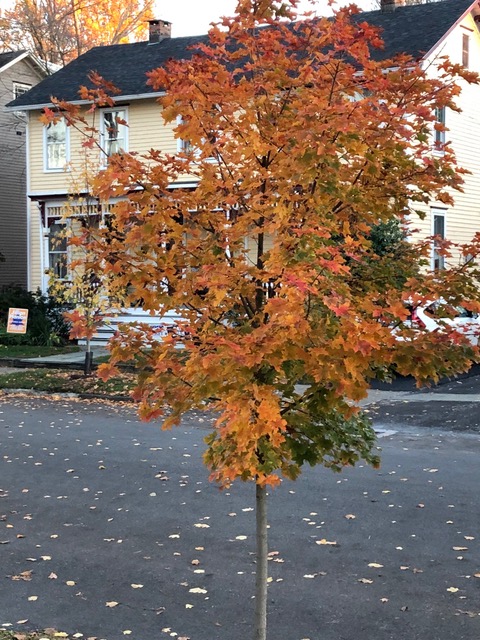
By October, Anemone Honorine Jobert is in full bloom – luminous white flowers catching the last of the light, brilliant alongside Fothergilla coloring up for Fall.  On the street, the Shantung Maples planted last year are earning their keep. They are still in full color, holding their leaves long after the other street trees have shed theirs.  The Winged euonymus, buried in the back of the garden, is a vibrant red as is the Aronia along the driveway.  


Shantung Maple

The lawn (a euphemism for Creeping Charlie and his cousins cut down as grass) is carpeted in yellow -- fallen leaves from the black walnuts first, then the maples.  Leaf-raking doesn’t start here till all the leaves have fallen.  Happily, what might appear messy to some is glorious to me.   Delfino Martinez and his crew have taken over leaf-raking -- what would be the householder’s task if the householder was someone other than myself.  


The Lawn Before Clearing

When the time approached to bring the potted tender plants indoor I balked; they had grown too large to winter-over in the house, and I turned the job over to Cheshire Nursery in Connecticut.  A truck picked them up and drove them down to Connecticut. The nursery will store them over the winter and return them in the spring – I hope.  One huge mandevilla, two sentimental plumbago, one tree fern, and one lemon tree.


Daylight Savings Time has ended and we are back to Standard.  Holiday catalogs are arriving with the anticipated selection of potted amaryllis.  If you are ambitious and have a space to store them, it is possible to coax amaryllis into a second flowering.  After they have finished blooming remove the flower stalk and fertilize monthly with Miracle-Gro or equivalent.  By mid-summer cut back on your watering schedule by one-half.  Once the foliage has yellowed cut the leaves back to an inch above the bulb and store the pots in a dark, cool location for about six weeks. Then bring them into a sunny window and start all over again.  


I should say that I don’t do any of this, but you might well want to.  I buy one fresh amaryllis each year and devote the rest of the winter to paperwhite narcissus planted in pebbles.  I always have a few bowls waiting in the wings, and one in a window with good light.


Paperwhite Narcissus

By the end of this month you should have completed putting the garden to bed for the winter, turned off and drained all outside water lines, coiled your hoses and brought them indoors.  Make sure your garden equipment and tools are clean; you can oil them over the winter.  When everything is cut down, put away, tidied up, mulched, wrapped and swept you can review your gardening year from a comfortable chair and plan for spring.

Friday, August 26, 2022

Covid In The Garden

In March of 2020, from my window in New York City, I watched families load up their SUVs and drive off not to return for months, if ever.  On the 16th, when rumors spread that Mayor DeBlasio would close the bridges and tunnels I too left, headed north, and remained in Rhinebeck till late Fall.  I left, feeling like a deserter.


The change was immediate.  First it was the quality of light.  In an apartment, even the best, there is usually only one good aspect and, maybe, a view. In a house there is light on all four sides. And I knew that within a few weeks, everything would start to grow again.


The garden was planned to begin in April, so I had a few quiet weeks ahead of me.  I’d planted daffodils for March in the border I share with my neighbor. Thanks to her, our shared garden is blanketed early with the most beautiful forget-me-nots.  Behind the house, the season starts with the earliest scillas planted long before I came here, surfacing every year no matter how disturbed the soil.  The scilla is followed by Phlox divaricata, mounds of blue, succeeded by amelanchier, astilbe, and by June/July the glorious Hydrangea arborescens White Dome, the anchor of the early garden.


Phlox divaricata


While the garden has been my joy, it is not my solace; it is too demanding for that.  Something is always saying “prune me, feed me, weed me, mulch me” and I am increasingly unable to comply.  I have helpers; gardening alone is a myth -- but that is a subject for another time.


The garden is in its sixth season.  We have had some losses, some surprises, and always something new.  The last surviving Japanese maples (two out of the initial six) succumbed to verticillium wilt. They have been replaced with four Sweet Gums at the north end and two Amelanchiers at the south.  


The Apple Tree's Final Bloom


The apple tree at the end of the long view died in its third year and has been replaced with a dogwood, Cornus florida, the least temperamental in that family.  Our losses are becoming worrisome.  There will be nothing left to try after this, only a stone monument to our failures.  We watch and wait.  


During 2020-21, I had visitors in the garden from earliest spring until winter set in.  Furnishings have come and gone.  I started out with six webbed folding chairs (first green and white, then a more sophisticated black), inexpensive, looking great, but too unstable for me.  After falling over the side a third time I replaced them with steel Windsor chairs that are almost impossible to dislodge.  A useful table will most likely be the next addition.


One of Four Sturdy Chairs

I suspect we all have a Covid misstep or two in our recent past.  My first was a longed-for equipment change.  After not writing for months, I was convinced that I was held back solely by the size of my screen and that a 21” monitor would change my life.  But what had been a merely languishing work ethic ground to a full stop in the face of a tangle of new equipment and cables.  The brains of the operation resided in my faithful laptop, which was always connected to the new equipment and thus closed, relegated so to speak to a back burner. 


This has proved to be too many moving parts for me, and I seem to be resistant to change. I don’t know what this means:

-       Do old habits die hard?

-       Do delusions of grandeur lead to diminishing returns?

I will not give up on this.  And my technical advisor, with the patience of a saint, continues to stand by. 


The second misstep was a true folly, and much more costly.  It was the dream of a Front Porch.  The huge maple street tree shading the house was so rotted it had to come down, providing the impetus for the porch.  The dream was to tie a front porch to the Livingston Streetscape, where every house has one.  The architect, much admired and deeply respectful of the historic district in which we live, drew up several possibilities.  My family was consulted.  All options were weighed, a selection made, working drawings finished.  When we realized that due to setback requirements, we would have very little usable space built at a very high cost, and that a porch would block the light into the house from the south, we went into full retreat. Instead, I replaced a hazardous sidewalk with new/old bluestone, planted two street trees, and – once again – revised the planting against the house.


One of Two Shantung Maples

Trish Pappendorf of The Valley Gardener transformed the bed with a silvery gray-blue palette new to me - lavender, calamintha, stachys, gaura, dwarf fothergilla - all keeping company with the existing Anemone Honorine Jobert.  The butterflies and bees form a cloud along the walk bordering this bed, too busy all summer to even notice you passing by, no less attack.


By late October it will be time to return to the city and answer the demands waiting there for me.  When a very young woman was asked why she lived in New York City, she replied “my stuff is here.”  I think it was her metaphorical stuff – her world, her dreams, who she is now and who she will become.  While I would love to stay here in Rhinebeck, my stuff is still in New York City.